
The Channel Check Goes Machine-Readable


GAII Intelligence · Research note
How AlphaSense, Hawkshaw, Trata and a new generation of AI-native research firms are turning the oldest edge on the buy side into structured, testable signal.
Last week, on October 6, AlphaSense launched Channel Check Intelligence (CCI), a layer that reads its whole library of structured channel checks and tells investors which sectors and companies are inflecting, and why. AlphaSense began running structured checks just over a year ago. It now produces about 3,000 a month, compliance-reviewed and with no embargo. That is far more than any analyst can read. CCI is AlphaSense’s answer to that problem.
Charlie Zvibleman of AlphaSense called it “the best new source of idea gen.” A week earlier, our own Kian Ghazi of Columbia Business School, a fundamental long/short investor for nearly 30 years, made a sharper point about Hawkshaw Insights. Investors, he wrote, “don’t need more information. They need better signals and measurable alpha.”
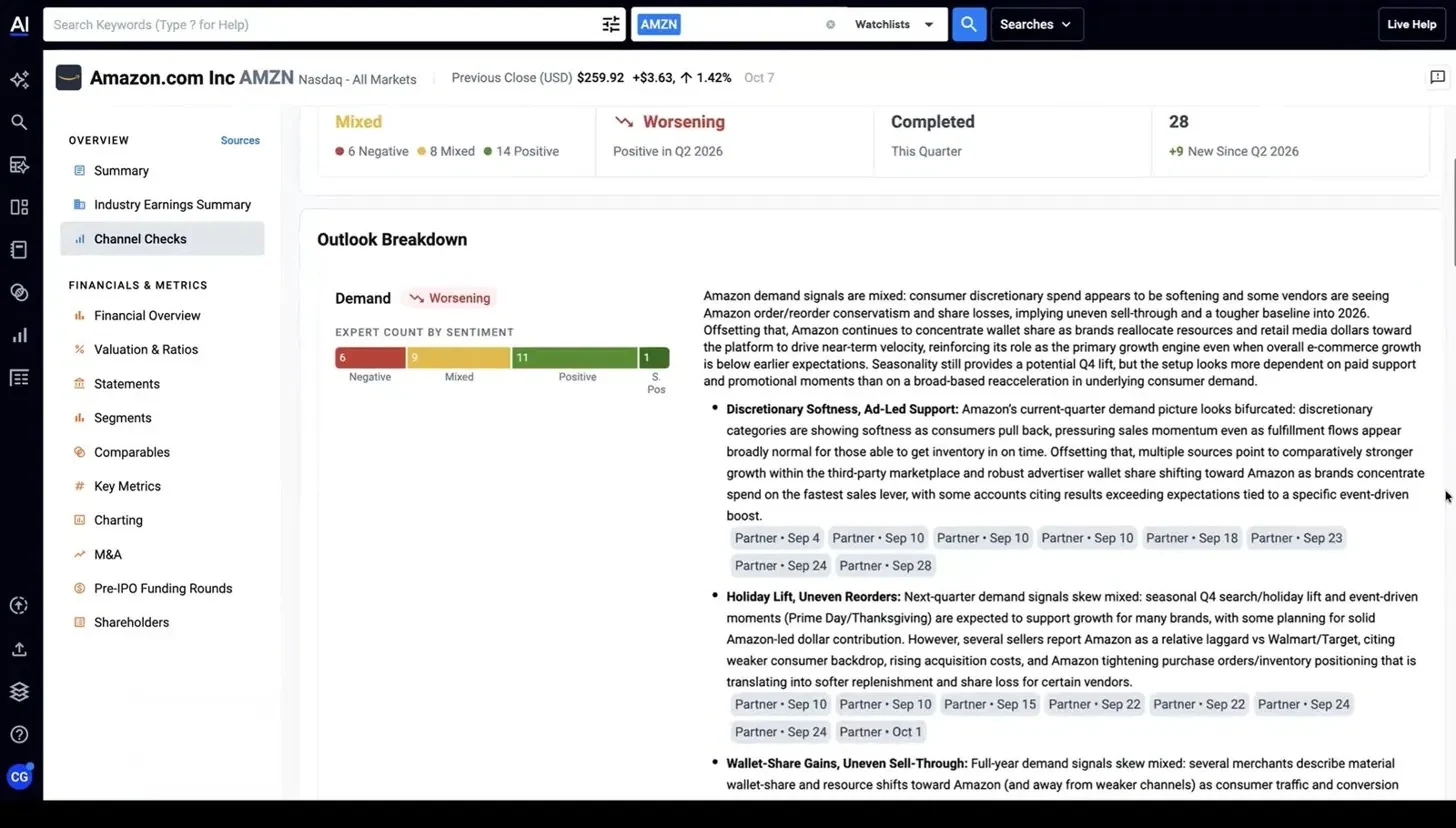
Those two statements frame the shift which is happening in the marketplace. Channel checks used to be a craft: slow, costly and dependent on who you knew. They are now becoming a data product: frequent, structured and comparable across companies. With access to channel checks now so easy, the key question is whether the checks you get add up to a measurable edge.
This piece discusses the current landscape in the market and is part of the GAII Intelligence coverage we run at the GAII Institute, where we track AI vendors in investment management the way a sell-side analyst covers stocks.
Why channel checks were always valuable, and always hard to use
A channel check is a conversation with someone who sees a company’s business before the market does: a reseller, a distributor, a customer, a competitor, a supplier. Their job is to answer one question early: is demand, pricing or share moving in a way the consensus has not priced in yet?
For decades this was among the most dependable sources of fundamental edge on the buy side. It was also one of the least scalable. Four problems held it back:
- Cost and access. Good checks came from boutique channel-research firms, sell-side surveys or expert-network calls at $1,000+ an hour. Coverage depended on budget and relationships.
- No structure. A transcript is an hour of unstructured talk. Two calls on the same company rarely asked the same questions, so you could not compare them or add them up.
- Too much to read. Expert transcript libraries now hold hundreds of thousands of documents. More checks produced more reading, not more conviction.
- Compliance and timing. Material non-public information risk meant review, embargoes and delays. A check that arrives after the print is history and the signal is not really useful.
As I’m monitoring what’s been happening in the market, I see that AI is on the path to change all four at once. AI interviewers run the same question guide on hundreds of experts a month at low marginal cost. Language models turn each call into structured fields, such as demand up or down, price increases sticking or not, and inventory high or low. Those fields can then be aggregated, trended and back-tested like any other dataset. So essentially, what’s been happening is that the channel check is not really an anecdotal transcript document and is increasingly becoming a time series.
AlphaSense Channel Check Intelligence: structure the data once, for everyone
AlphaSense’s bet with this new product is at its core scale plus pre-computation. It owns the largest expert-transcript library in the market (Tegus, acquired in 2024). It added an AI interviewer and a structured channel-check program in August 2025. CCI, launched October 6, 2026, is the analytical layer on top.
This is how it works
Collection
AI-led interviews with suppliers, distributors and customers, run on a consistent question set each quarter. Every call is pre-screened and reviewed for MNPI. AlphaSense cites 9,000+ checks a quarter across 100+ industries.
Structuring
Models read every check and sort each company’s findings into demand, supply, pricing and competition. KPIs that experts cite roll up into means, medians and ranges.
The read
Each of 750+ tickers gets a verdict-first summary: what the channel says now and how that changed quarter on quarter. Every claim links to the quote, expert type, date and full transcript.
Monitoring
Reads refresh daily. Alerts flag changed reads, contrarian calls and inflections between earnings.
The bigger idea is pre-compute. CCI uses LLMs to structure the data once, for everyone, so no analyst has to re-read hundreds of transcripts. The next step is wiring it into SuperAnalyst, AlphaSense’s agent. When an analyst builds an earnings preview, the system will pull in CCI automatically and can use it as an input to model assumptions. That saves time, improves accuracy and cuts token costs, because the analysis is not rebuilt from scratch.
Example workflow. An analyst covering a software name opens CCI three weeks before the print. The read says partners report deal cycles lengthening and discounting rising, a change from last quarter’s “steady.” The analyst clicks through to six reseller quotes, checks the dates, and trims the revenue assumption before consensus moves. That is the use case: spotting a change in direction early, with the evidence attached.
Our view. CCI’s strengths are breadth, consistent questions, auditability and distribution inside a platform most large funds already pay for. Its main risk is the flip side of that last point. A verdict that every AlphaSense client sees at the same moment will be priced in faster. The edge shifts from having the check to interpreting it first, combining it with other data, and acting on it. AlphaSense also does not yet publish a measured link between CCI signals and subsequent returns.
Hawkshaw Insights: from information to measured alpha
If AlphaSense is the scale play, Hawkshaw Insights is the PM’s play. It was built by Kian Ghazi, who has spent nearly 30 years in fundamental long/short investing and founded Hawkshaw Capital Management. It starts from a different question: is the incremental information generating alpha?
How it works. Hawkshaw takes a narrow universe, enterprise software, and tracks the KPIs that actually drive revenue growth. For each company it scores five drivers every quarter: new demand, win rate, pricing, seat expansion and cross-selling. Each is rated on a scale from Weakening through Mixed and Steady to Strengthening. The drivers roll up into a single directional signal. The aim is to catch a fundamental inflection before it shows up in reported results.
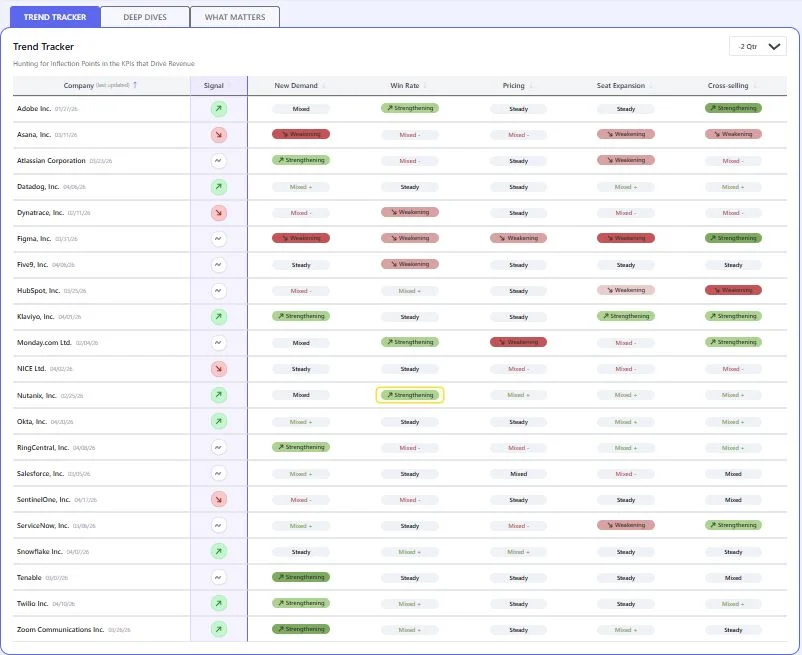
The screenshot shows the design. Instead of a paragraph about Monday.com, you see Win Rate “Strengthening” next to Pricing “Weakening”: a company winning deals by giving up price. Figma shows weakening demand, win rate, pricing and seat expansion, offset only by cross-selling. Patterns like these are what a PM wants to see at a glance, and they are hard to find by reading transcripts.
The differentiator is measurement. Hawkshaw publishes its own scorecard. Since launch last year it has flagged 27 positive and negative revenue-growth inflections. Those stocks averaged:
All figures versus IGV, as reported by Hawkshaw’s founder.
The sample is still small, but the discipline matters. Ghazi cites Neudata‘s latest investment-manager survey: the most common reason data trials failed to convert was “no discernible signal,” and only 17% of data buyers said AI had improved investment performance. Hawkshaw is built to answer that objection directly.
Where it fits. Hawkshaw suits sector specialists and PMs who want a short list of names where the fundamental story is changing, with a track record they can test. The trade-off is breadth: one sector, a few dozen names. Hawkshaw is offering a one-month free trial across its software coverage, timed to the current software earnings season.
Trata and the wider field
Trata: the buy side’s own check. Trata (Y Combinator, Winter 2025, New York) flips the source as it doesn’t interview the channel: instead, it interviews the investors who follow the channel. AI agents hold dozens of short, anonymous conversations a day with analysts at large hedge funds about stocks they know well. Trata then publishes the debate: the bull and bear narratives, the KPIs that matter and the signals people are watching (launch post). Contributors review and redact their content, and Trata says it works with fund compliance teams and has lawyers review for SEC compliance.
Founder Eric Cho spent 4.5 years as a senior analyst covering global tech at a long/short fund. The pitch is about speed: an analyst can spend three or more hours just finding the key debate on a new name. Trata’s value is positioning intelligence: what smart money thinks the debate is, which is often where a channel check is most useful. It is not primary channel data, and it carries the obvious risk that contributors talk their book.
The rest of the field. Channel-check intelligence is becoming a category in AI products and right now, at least four groups are converging on it:
- Expert networks adding AI interviewers. GLG launched AI-Moderated Calls in August 2026: an agent runs client-designed interviews, including multiple-choice and scale questions that export to Excel, in ten languages across a network of more than one million professionals. That turns the expert call into a survey instrument. Third Bridge has opened its 100,000+ transcript library to LLMs through an MCP server, so a fund’s own agents can do the structuring.
- Survey-based spending data. Enterprise Technology Research (ETR) surveys nearly 10,000 IT decision-makers on spending intentions. For software investors it is the quantitative cousin of a channel check. Futurum Group agreed to acquire ETR’s parent in May 2026.
- Legacy channel-research boutiques and sell-side surveys. Firms that call resellers and distributors every quarter remain the benchmark for depth and judgment. Their challenge is that AI makes their core product, the structured check, cheaper to copy.
- Alternative-data KPI trackers. Firms such as YipitData and M Science estimate revenue KPIs from transaction, web and app data. They answer “what happened” with numbers; channel checks answer “why” and “what next.” The two are complements.
The landscape at a glance
The providers are not really competing on the same thing. Each owns a different layer of the stack, and the value per dollar rises as you move up.
Value moves up the stack, from collecting checks to proving alpha
The channel-check intelligence stack, with the providers at each layer
Collect
Talk to the channel. Who you can reach, and how often.
Structure
Turn calls into fields: the same questions each quarter on demand, pricing, supply and competition.
Signal
Detect the inflection: change versus last quarter, scored by revenue driver, before the print.
Prove
Measure the alpha. Few vendors publish this, and it is the first question buyers should ask.
Most of the market still sells layer 1. AlphaSense is moving from layer 1 into layers 2 and 3. Hawkshaw starts at layer 3 and is the only one here that publishes layer 4.
| Provider | Approach | Where the insight comes from | What you get | Value proposition | Watch-outs |
|---|---|---|---|---|---|
| AlphaSense CCI | Scaled AI-led channel checks plus LLM structuring | ~3,000 checks a month with suppliers, distributors and customers; 750+ tickers, 100+ industries | Verdict-first read per company on demand, supply, pricing and competition; KPI ranges; daily alerts; every claim linked to its quote | Breadth and auditability inside a platform funds already use; feeds SuperAnalyst earnings previews and model assumptions | Same verdict reaches every client at once; no published return track record yet |
| Hawkshaw Insights | PM-built KPI inflection tracker | Proprietary research on the revenue drivers of enterprise software companies | Quarterly scores on new demand, win rate, pricing, seat expansion and cross-selling; one directional signal; deep dives | Measured alpha: 27 inflections, +7 pts 1-day and +20 pts 90-day vs IGV, 70% hit rate | One sector; small sample so far |
| Trata | AI interviews of buy-side analysts | Anonymous hedge fund analysts and PMs | Bull and bear debate, key KPIs and catalysts per stock | Gets you up to speed on the debate in minutes rather than hours | Opinion, not primary channel data; contributors may talk their book; early-stage company |
| GLG AI-Moderated Calls | Run-your-own AI interviews | 1M+ expert network, 10 languages | Transcripts, synthesized themes, survey-style answers exported to Excel | Your own question guide, run at scale and in parallel | You still build the structuring and signal layers yourself |
| Third Bridge | Transcript library opened to LLMs | 100,000+ expert interviews on 75,000+ companies | Natural-language access through an MCP server inside your own LLM | Bring your own agent; the library becomes an input to your workflow | Interviews are not run on a consistent quarterly panel |
| ETR | Survey of technology buyers | Nearly 10,000 IT decision-makers | Spending intentions and vendor share shifts | Quantitative, repeatable read on enterprise tech demand | Tells you what buyers plan, less about why; being acquired by Futurum |
| Legacy channel boutiques | Analyst-run quarterly reseller and distributor calls | Long-standing industry contacts | Written notes with an analyst’s judgment | Depth, context and relationships | Expensive and hard to scale; core product easier to copy with AI |
How to evaluate a channel-check product
The right test is not about how many checks a vendor runs but whether its output changes a position before the market does. In our GAII Intelligence work we ask six questions:
Is the panel consistent?
The same expert types, asked the same questions each quarter, are what make the data a time series. Without that, a “change” may just be a different person answering.
Is it point-in-time?
A back-test only counts if each signal is stamped with the date it was available, not with hindsight. Ask for the timestamps.
Is there a published hit rate?
Ask for the vendor’s equivalent of Hawkshaw’s scorecard: number of calls, alpha versus a sector benchmark, and over what horizon. “Customers love it” is not a signal.
How crowded is it?
A signal sold to 80% of the top hedge funds decays faster than one sold to 30 funds. Breadth helps idea generation; exclusivity helps alpha.
Can you audit it?
Every claim should trace to a quote, an expert type and a date. Investment committees and compliance teams will ask.
Does it plug into your workflow?
Pre-computed signal is worth more when it flows straight into models, screens and earnings previews, through an API, MCP server or agent, rather than another dashboard to check.
Three ways funds are using these tools now
Idea generation
Screen the coverage universe weekly for names where two or more revenue drivers flipped direction. Hand the short list to the sector analyst.
Earnings preparation
Three to four weeks before a print, compare the channel read with consensus revenue and margin assumptions. A gap is a position-sizing input.
Thesis monitoring
Set alerts on the one or two KPIs your thesis depends on, such as pricing or seat expansion. Exit when the channel turns, not when the quarter does.
What comes next
The channel check is turning into a structured, continuous and testable data stream. That will change who wins. Scale players such as AlphaSense will make the basic channel read a commodity. Its value will then sit in how fast it feeds the analyst’s model, which is exactly where CCI and SuperAnalyst are heading. Specialists such as Hawkshaw will compete on depth in one sector and a published record of alpha. New entrants such as Trata will find gaps the incumbents ignore, such as the buy side’s own debate.
For investors, more channel data is not the edge. The edge is a disciplined process that turns these signals into earlier, better-sized decisions, and evidence that it worked.
This article is part of GAII Intelligence, the GAII Institute’s research coverage of AI vendors in investment management. In upcoming pieces we will go deeper: hands-on evaluations of each platform, side-by-side reads on the same companies, and our own scoring of signal quality and alpha. More on that soon.
Disclosure: Hawkshaw’s figures are as reported by its founder; its signals shown are historical, not current. AlphaSense, GLG, Third Bridge and ETR figures are company-reported. Nothing here is investment advice.
Sources
- AlphaSense, Channel Check Intelligence press release, October 6, 2026
- AlphaSense, Channel Check Intelligence product article and demo video, October 15, 2026
- AlphaSense, AI interviewer and Channel Checks launch, August 19, 2025
- Charlie Zvibleman, post on X
- Kian Ghazi, post on Hawkshaw Insights; LinkedIn profile
- Y Combinator, Trata company page; Fondo, Trata launch post, February 9, 2026; Airframe, Trata profile
- Integrity Research, GLG launches AI-Moderated Calls, August 24, 2026
- Third Bridge, AI tools for investment research
- Business Wire, Futurum to acquire ETR parent Aptiviti, May 27, 2026
Get GAII Insights by email.
New essays, research and event invitations, about twice a month.




Responses