
Autonomous Trading by Interactive Brokers: What AI Agent Use Means for Investors


Perspectives · Autonomous trading
With Autonomous Trading, Interactive Brokers now lets clients hand an AI agent the keys to part of their account. The first version is small and fenced in. The idea is not. Here is what is actually new, what could go wrong, and what it means for fundamental investors.
What happened: IBKR launches Autonomous Trading
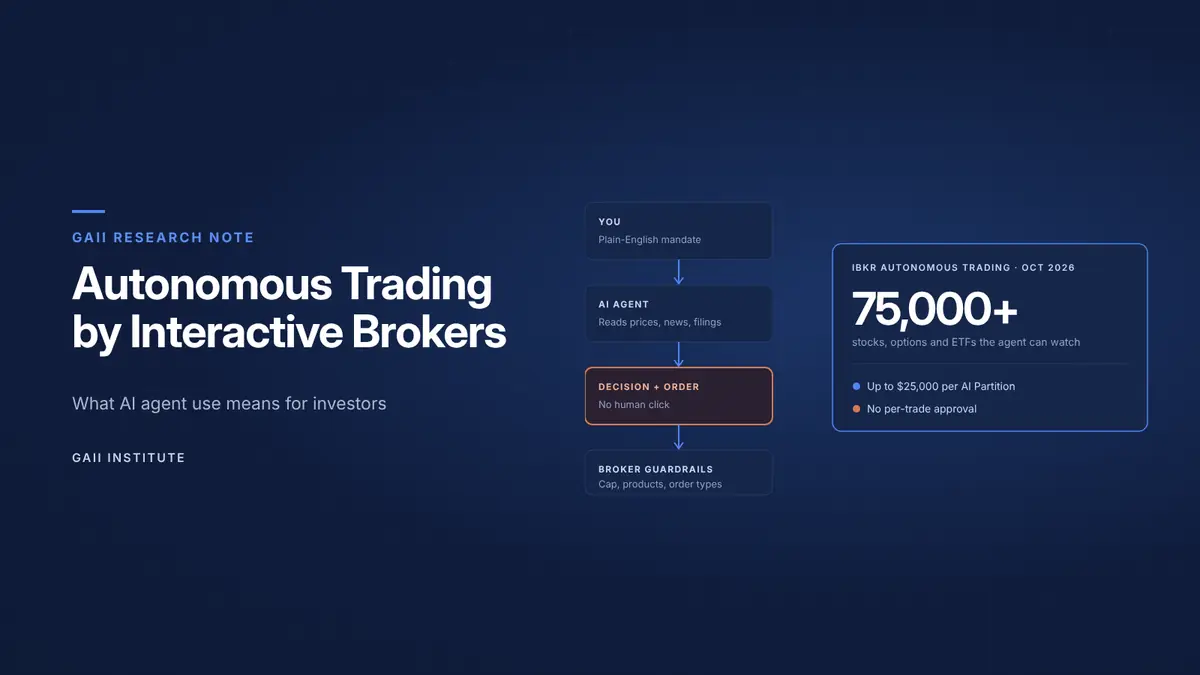
On October 21, Interactive Brokers (IBKR) announced IBKR Autonomous Trading. Eligible clients can now authorize a connected AI platform to watch more than 75,000 stocks, options and ETFs worldwide and submit orders without approving each trade. Until now, IBKR’s AI integration with ChatGPT, Claude, Grok and Perplexity could suggest orders, but a human had to click “approve.” That step is now optional.
Clients give the AI a mandate in plain English. IBKR’s own examples read like instructions to a junior trader: trim any position above 10% of the portfolio back to 8% each morning; sell 30-day covered calls when a holding’s implied volatility reaches its 52-week 90th percentile; send a brief if a position falls 7% from its 20-day high.
The first version comes with tight fences, according to reported launch terms:
| Feature | At launch |
|---|---|
| Money at stake | A separate “AI Partition” inside the account: up to 10% of account equity, minimum $1,000, maximum $25,000 |
| Who can use it | Eligible individual, non-margin accounts only. Joint, retirement, advisor-managed and institutional accounts are excluded |
| Training wheels | Clients must first approve at least 10 AI-generated trades of $100 or more within two weeks |
| What it can trade | Eligible stocks and equity options; market, limit, stop and stop-limit orders, day orders only |
| What it can’t | No margin, no short selling, no fractional shares, no penny stocks |
| Kill switch | Clients can disconnect the AI in the Client Portal, but disconnecting does not automatically cancel orders already sent |
| Rollout | About 3,000 clients invited first, from those already using the human-approved AI connector; IBKR says this “is going to greatly increase” |
IBKR is not alone. Public launched “AI Agents” in March, Robinhood is testing “Agentic Accounts,” eToro offers “Agent Portfolios” from $200, and Gemini opened agentic trading for crypto in April (Corporate Insight). IBKR matters because of who its clients are: 5.58 million accounts, up 35% in a year, and the most active, most global retail base in the business.
Is this new, or has it been around for years?
Both. Machines have been trading for decades. Algorithms already generate most U.S. equity volume. Retail investors have had stop-losses, bracket orders, conditional orders and broker APIs for a long time, and IBKR itself has been an automation-first firm since its founding. Robo-advisors have rebalanced portfolios automatically since around 2010.
What is new is who writes the rules and how.
| Classic automation | Quant algorithms | Generative AI agents | |
|---|---|---|---|
| Who sets it up | The investor, order by order | Professional developers | Anyone, in plain English |
| How it decides | Fixed trigger: “sell if below $50” | Coded model, tested on history | A language model interprets a goal and the data, then chooses |
| What it reads | Price | Structured data: prices, fundamentals, some text | Prices plus news, filings, transcripts, social posts |
| Predictability | Fully predictable | Predictable within the model | Can vary with wording, context and model version |
| Who uses it | Retail and pros | Mostly institutions | Retail first |
The AI angle, and the generative AI angle
A stop-loss is automation. It does exactly one thing when one number is crossed. An autonomous agent is different in three ways.
It turns intent into orders
“Keep me diversified and harvest premium when volatility is rich” is a goal, not a rule. The model decides what that means each day. That is the convenience and the risk.
It reads the news
An agent can read an earnings release, a downgrade or a viral post and act on it in seconds. Retail investors now have a text-reading machine that only funds used to have.
It decides when, not just how
Old automation executed a human decision. The agent makes the decision within limits. The human sets the guardrails, not the trades.
That last point is the real shift. In our recent piece on AI personas (Should Your AI Think Like a Portfolio Manager?), we reviewed research showing that language models’ forecasts follow the wording of the prompt and any number put in front of them, more than any stable belief. An agent that trades on those judgments inherits the same quirks, now with money attached.
How it works, step by step
First, how the pieces connect. The AI does not live inside Interactive Brokers. It runs in the cloud, on the AI platform the client chooses, and reaches the brokerage account through a standard connector called the Model Context Protocol (MCP). IBKR says the link works without the client sharing passwords or API keys.
How an AI agent connects to an IBKR account
The client sets the rules; the AI in the cloud acts through MCP; the broker enforces the fence.
Investor
Writes the mandate and safeguards in plain English. Funds the AI Partition.
AI platform
Claude, ChatGPT, Grok, Perplexity or another MCP-compatible agent. Reads data and news, decides.
MCP link to IBKR
Reads positions, prices, P&L and alerts. Sends orders. No passwords or API keys shared.
IBKR AI Partition
Capped account. Checks every order against the limits, then routes it to exchanges. Kill switch in the Client Portal.
Then, what happens on each trade:
Investor sets the mandate
Strategy and safeguards in plain English. Funds a capped AI Partition from the main account.
AI platform connects
ChatGPT, Claude or another agent links to the account through the Model Context Protocol (MCP), without sharing passwords.
Agent monitors
Prices, volatility, positions, news and filings, continuously.
Agent decides and sends the order
No human click. This is the step that is new.
Broker checks the guardrails
Capital cap, permitted products and order types, account rules. Orders outside the fence are rejected.
Order hits the market, and the loop repeats
Fills are logged; the investor can review and disconnect at any time. Orders already sent stay live until cancelled.
Note who is responsible at the end of that chain. IBKR warns that third-party AI can submit erroneous or unintended orders, and that the client remains responsible for every trade.
Pros and cons
Discipline at scale
Rules followed every day without emotion or forgetfulness: rebalancing, trimming winners, harvesting option premium, cutting losers. Faster reaction to information. Strategies that once needed a coder now need a paragraph. Caps and partitions limit damage while people learn.
Delegated mistakes, at speed
Ambiguous instructions get creative interpretations. Models can misread news or hallucinate. Behavior can change with a model update. Many agents built on a few models may act alike. A false sense of safety for inexperienced investors. Unclear liability when an agent errs.
Will autonomous trading increase volume tremendously?
Not right away. With 3,000 invited clients and $25,000 caps, the launch is a rounding error next to a U.S. equity market that averaged 17.6 billion shares a day in 2025 (Cboe). But IBKR’s own management is clear about the direction. CEO Milan Galik told analysts that the human-approved AI connector was “one of the fastest adopted features we have ever introduced” and that the firm expects “higher trading volumes related to AI adoption over time” (AIM Media House).
The logic is simple. A human checks the portfolio a few times a week. An agent checks it every minute. Rules like “trim back to 8%” or “sell calls when volatility spikes” generate many small trades that a person would skip. Expect more trades per account, smaller in size, especially in options.
Is there a precedent for autonomous trading?
Yes, and the pattern is consistent: whenever trading gets easier, people trade more, and the market structure adjusts around them.
| Change | What happened | Lesson for AI agents |
|---|---|---|
| Zero commissions (2019) | Schwab, TD Ameritrade and E*Trade cut commissions to zero in October 2019. By early 2020, daily trades at online brokers had roughly doubled year over year (CNBC), helped by the pandemic. | Lower friction means more activity. Agents remove the friction of attention itself. |
| Fractional shares (2019–2020) | Buying $5 of an expensive stock became possible, pulling small accounts into high-priced names. | Access changes who owns what, not just how often they trade. |
| Meme stocks (2021) | Social media coordination, free trading and call options drove GameStop and others to extreme moves. | Correlated retail behavior can overpower fundamentals for weeks. |
| Zero-day options (2022–) | Daily expiries became a large share of S&P 500 options volume. | New tools can quietly reshape intraday dynamics. |
| Flash Crash (2010), Knight Capital (2012) | Automated selling briefly erased about a trillion dollars of value in 2010; a faulty algorithm cost Knight Capital about $440 million in 45 minutes in 2012. | Automation fails fast. Circuit breakers and kill switches came after the fact. |
Volatility, sudden moves and meme stocks
The main worry is herding. In June, Democratic members of the House Financial Services Committee wrote to the SEC warning that agents trained on similar data could produce “correlated trading decisions” and “herding behavior,” increasing volatility in stressed markets (WealthManagement.com). The concern is real. Millions of investors may end up running a handful of foundation models, reading the same headlines, with similar instructions copied from the same online templates. Diversity of opinion is what makes markets stable. Agents could reduce it.
Where it could add sudden moves: around earnings, downgrades and breaking news, when many agents react within seconds; in smaller stocks with thin liquidity; and in options, where many agents following the same rule can push implied volatility.
Where it could dampen them: many popular instructions are contrarian by nature. “Trim winners back to target” sells into rallies. “Sell covered calls when volatility is high” adds supply of options exactly when they are expensive. Rebalancing rules buy dips. A market full of disciplined rebalancers could be calmer, not wilder.
Meme stocks: the first version blocks some of the fuel. No margin, no shorting and no penny stocks rule out the most explosive setups. But equity options are allowed, and an agent told to “buy what’s trending” would do so faster and more consistently than any human crowd. The next meme rally may be organized not on Reddit but in the instructions people give their agents.
Scenarios: what might happen
| Scenario | What it looks like | Likely market impact |
|---|---|---|
| 1. Niche tool (next 12 months) | Caps stay tight; a few hundred thousand users across brokers; mostly rebalancing and option-income rules | Negligible on prices. More small trades and option overwriting at the margin |
| 2. Mainstream retail (2–4 years) | Caps rise, margin and shorting allowed, agents become a default feature at major brokers | Meaningfully higher retail volume; faster, more uniform reactions to news; richer liquidity in calm markets |
| 3. Herding shock (any time) | A widely used model misreads a headline, or a viral prompt spreads; thousands of agents sell the same names at once | Sharp intraday drops in specific stocks or sectors, quickly reversed. A “mini flash crash” followed by new rules |
| 4. Regulated equilibrium (3–5 years) | SEC and FINRA set standards on agent oversight, liability, throttles and testing | Agents become like robo-advisors: widespread, boring, and mostly stabilizing |
Our base case is scenario 1 turning into scenario 2, with at least one scenario 3 episode along the way. That episode is likely to be what eventually produces scenario 4.
A hypothetical: one stock, one morning
The following is an illustration only. The numbers are invented, not a forecast for any company.
Imagine a mid-cap retailer, call it “Northfield Home,” trading at $60. It reports quarterly results at 7:00 a.m. Revenue beats estimates, but the headline says “gross margin declines 120 basis points.” Buried on page 9: the decline came from a one-time inventory write-down tied to a product recall that is already resolved.
Nothing in this story requires bad technology. It requires many agents with similar, simple instructions reading the same headline at the same time. The winners were the investors who read page 9.
Implications for funds
More flow, more predictable
Market makers and short-term funds will study agent behavior the way they once studied retail order flow. Rule-based agent trades around rebalancing thresholds and volatility triggers could become predictable, and therefore tradable.
Cheaper volatility, at times
If covered-call rules like IBKR’s example catch on, systematic call selling could compress option premiums in popular stocks when volatility is high.
New correlation risk
Stocks heavily held by agent-driven accounts may move together on news, regardless of fundamentals. Crowding measures will need a new input.
Wider short-term mispricings
Faster, more uniform reactions to headlines mean bigger gaps between price and value around events, for those with the patience to use them.
Should fundamental and value investors change strategy?
No, not the philosophy. Yes, the playbook around events.
Value investing has always made money from other people’s impatience. Autonomous agents are, in effect, impatience automated: they react to headlines, follow simple rules and sell at prices set by the first reading of the news. That is not a threat to fundamental investors. It is a supply of opportunity.
Where the opportunities are
- Event-driven overreactions: buying high-quality companies after agent-amplified sell-offs on misleading headlines.
- Selling options to agents, or buying from them: depending on which side the crowd’s rules end up on.
- Providing liquidity: for funds that can take the other side of fast, uniform flows.
- Building the picks and shovels: agent oversight, testing, audit trails and risk controls for brokers and investors. This is a new category of fintech, and one we are tracking in GAII Atlas.
Conclusion
IBKR’s autonomous trading launch is small by design: capped, partitioned and limited to a few thousand clients. But it crosses a line the industry has been approaching for years. For the first time, a major global broker lets software make and send trading decisions for ordinary investors without a human click.
The near-term market impact will be minimal. The long-term impact depends on three things: how quickly the caps rise, how similar the agents turn out to be, and how regulators decide who is responsible when an agent gets it wrong. For fundamental investors, the message is reassuring. The more trading is driven by fast, literal readings of the news, the more valuable slow, careful reading becomes.
Related from GAII Institute: Do Hedge Funds Actually Make More Money Using ChatGPT? · The “Exoskeleton” Approach: Why AI Won’t Replace Investors · The Channel Check Goes Machine-Readable
The hypothetical scenario is illustrative and does not refer to any real company. Nothing here is investment advice.
Sources
- Interactive Brokers, “Interactive Brokers Introduces Autonomous Trading”, October 21, 2026
- FinanceFeeds, “Interactive Brokers Autonomous AI Trading: $25,000 Cap”
- The TRADE, “Interactive Brokers rolls out autonomous AI trading”
- AIM Media House, “Interactive Brokers Built a Way for AI Agents to Trade Without You”
- Corporate Insight, “Fintechs Put AI in the Driver’s Seat with Agentic Trading”
- WealthManagement.com, “Lawmakers Press SEC on AI Trading Agent Oversight”, June 2026
- Cboe, “2025 U.S. Equities Year in Review”
- CNBC, “Trading volume for electronic brokers doubled last quarter”, May 2020
Get GAII Insights by email.
New essays, research and event invitations, about twice a month.





Responses