
Portrait Analytics: Initiation of Coverage
Coverage history
3 notes · ratings as published in each note| Date | Note | Rating · Score | Outlook | |
|---|---|---|---|---|
| 21 Oct 2026 | Coverage Update Latest GAII-IC-2026-040 | Emerging · 6.38 | Improving | Log in |
| 20 Oct 2026 | Coverage Update GAII-IC-2026-010 | Established · 7.05 | Improving | Log in |
| 27 Aug 2026 | Initiation of Coverage This note GAII-IC-2026-010 | Established · 6.6 | Under Evaluation | Log in |
Market Definition
GAII Intelligence defines the AI Research & Intelligence market as software that applies generative and agentic AI to the research process of professional investors: locating candidate securities, assembling and interrogating evidence, producing written analysis with traceable sources, and monitoring positions once held. Buyers are hedge funds, long-only managers, multi-manager platforms, family offices and allocators; the economic buyer is typically the chief technology officer, the head of research, or a portfolio manager with a technology budget.
Capabilities we treat as mandatory
- Evidence retrieval at scale: the ability to search and reason across regulatory filings, transcripts and news, and across documents the client supplies.
- Source traceability: every material claim in an output must be reachable back to the passage that supports it.
- Institutional data handling: a stated position on where client data goes, how long it is held, and whether it is used for model training.
Capabilities we treat as differentiating
- Persistent state: the system remembers a thesis, a coverage list or a position between sessions and acts on it without being re-prompted.
- Workflow surfaces: delivery inside the applications analysts already use — the spreadsheet, the research management system, email and messaging.
- Owned or exclusive content: material that a competitor cannot obtain by signing the same third-party contract.
- Published evaluation: a measured, disclosed accuracy methodology rather than an assertion of quality.
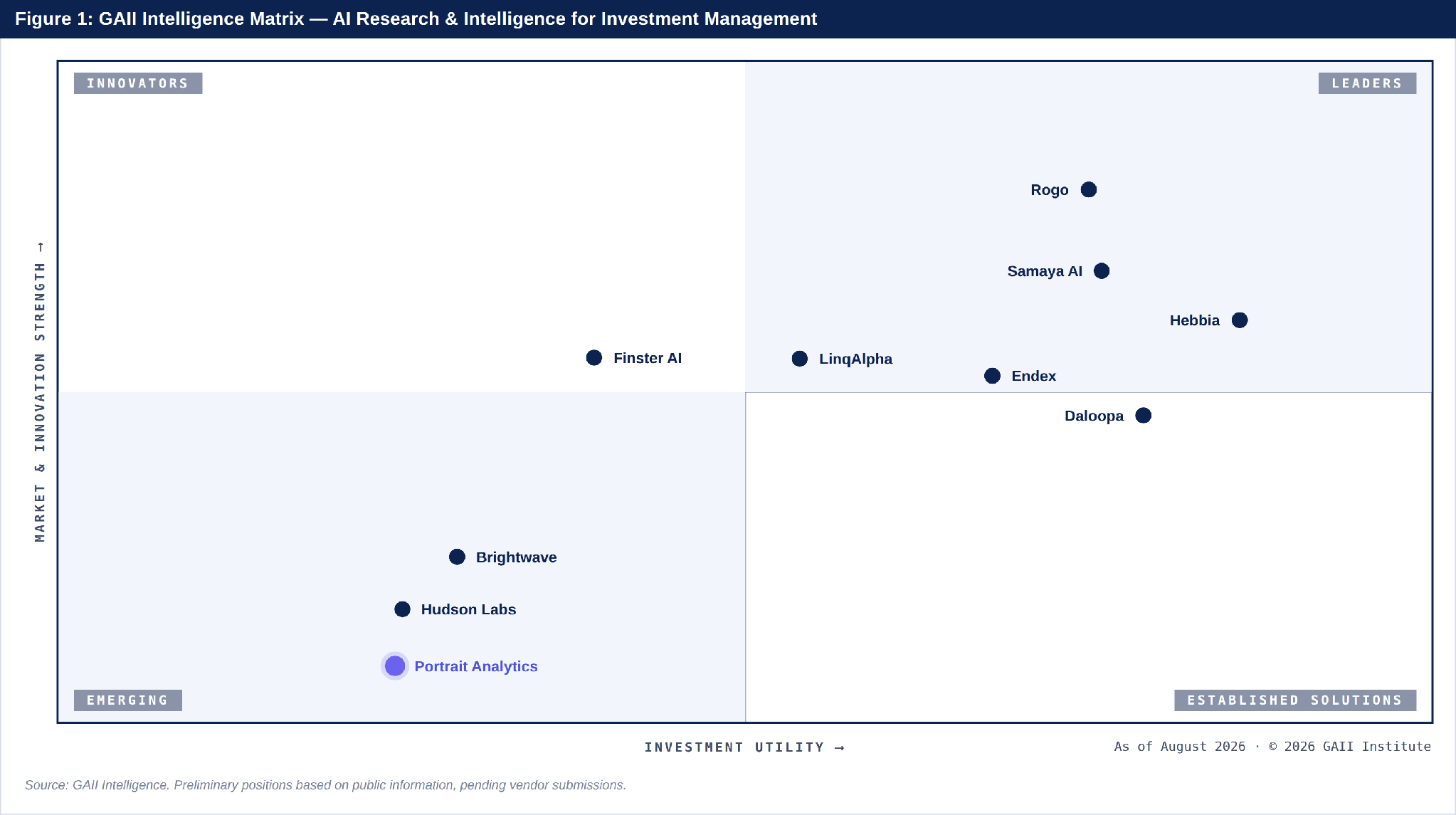
Portrait competes in the buy-side segment of this market. Its closest functional comparisons in our coverage universe are Brightwave, which has built comparable citation-backed research output, and Hudson Labs, which is similarly practitioner-built and capital-light. It does not compete directly with Rogo, whose centre of gravity remains investment banking, or with Daloopa, which supplies structured data rather than analysis.
Strengths
The following are the capabilities and characteristics that, in our assessment, most distinguish Portrait within the AI Research & Intelligence market. Each is drawn from publicly documented product capability, published interviews with management, or independent hands-on review.
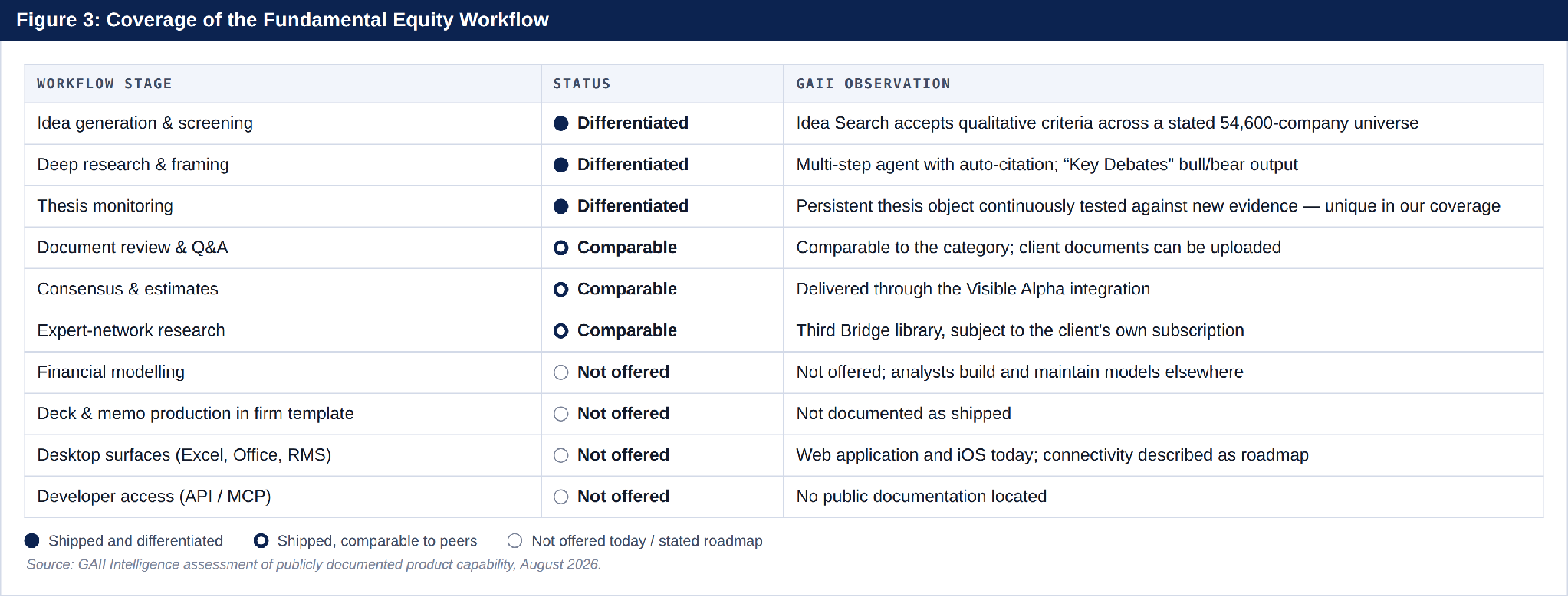
- Thesis monitoring: The analyst states an investment thesis and the system continuously tests incoming filings, transcripts, news and expert-call material against it, flagging evidence that supports or contradicts it. We have not identified an equivalent persistent thesis object elsewhere in our coverage universe; monitoring at other vendors is typically a saved search rather than a maintained position. For a manager holding forty to eighty names, this addresses the part of the process that is hardest to systematise.
- Qualitative screening: Idea Search accepts screening criteria that a conventional factor screen cannot express — for example, companies launching an adjacent business line material to revenue — across a stated universe of more than 54,600 companies, and ranks results against the firm's own stated framework. Independent hands-on review confirms the tool surfaces non-obvious names with a defensible rationale.
- Output shaped for a decision-maker: Deep Research presents contested variables as an explicit bull and bear framing under a "Key Debates" heading rather than as a neutral summary. Reference users consistently identify this as the differentiating element. It is the correct output format for a discretionary investor, who needs the argument rather than the abstract.
- Practitioner design: The company was founded by David Plon, who worked on the buy side at Baupost Group and Slate Path Capital before Barclays and Stanford GSB, and the team includes people from Citadel, Millennium and Goldman Sachs. The product decisions reflect that background — the sequence of the workflow, the framing of outputs, and the choice of what to leave out.
- Engineering density: Approximately nine of thirteen staff are engineers, an unusually high build ratio for a company of this size, and it is visible in the pace at which new surfaces have shipped.
- Content partnerships above its weight class: The Third Bridge expert-transcript integration and Visible Alpha consensus data give Portrait access to content usually associated with much larger platforms. Both are meaningful additions to the evidence base available to an analyst inside the product.
- Low-friction evaluation: A full-access one-week trial with white-glove onboarding, delivered by former analysts, allows a prospective client to test the product against live work at minimal cost. Support quality at this company size is a genuine advantage and was scored accordingly.
Cautions
The following are factors that prospective clients should weigh, and areas where our public review did not find sufficient evidence to reach a settled view. Several are common across vendors at this stage of the market and are not specific to Portrait. We encourage prospective clients to raise each of them directly with the company; we have done the same, and will update this note as answers arrive.
- Security and deployment documentation: We did not locate public evidence of a SOC 2 attestation, a customer-facing trust centre, single sign-on and audit-logging documentation, a subprocessor list, or a data-residency or private-cloud deployment option. This records the absence of public evidence rather than the absence of the capability. As several peers in our coverage now publish this material, firms with a formal vendor-review process should ask Portrait what it can supply and on what timetable.
- Funding and scale: No priced funding round has been disclosed since July 2023, and headcount is reported at approximately thirteen. This is consistent with either efficient operation or a deliberate decision to defer financing, and the two are not distinguishable from outside. Firms entering a multi-year agreement should discuss runway and consider standard protections such as data-egress commitments.
- Leadership: A published interview in July 2026 describes Eric Moster, previously product lead and formerly of Citadel and Millennium, as having recently become chief executive. The company has made no announcement, and we have not been able to corroborate the report. We treat this as unresolved and have put it to management directly.
- Content is licensed rather than owned: The Third Bridge and Visible Alpha relationships are non-exclusive, and the Third Bridge library is accessed through the client's own subscription rather than resold. As with many vendors in this category, this means the differentiating content could in principle be obtained by a competitor on the same terms, and that total cost of ownership is higher for a firm that does not already hold an expert-network contract.
- Broker and sell-side research: Portrait has no public position on broker research entitlements. This is a category-wide constraint rather than a Portrait-specific one — licensing restrictions on sell-side research are among the most-cited obstacles to buy-side AI adoption — but it is a real gap for firms whose research budget is concentrated there.
- Delivery surfaces: The product is a web application with an iOS companion. Financial modelling is not offered, and Excel, Office, research-management-system and API access are described as roadmap rather than shipped. Several competitors are moving in the opposite direction, and analysts spend most of their day in the spreadsheet. Firms should establish where Portrait sits in the daily workflow before committing seats.
- Depth of deployment: Approximately 250 active users across approximately 100 firms implies an average of roughly two and a half seats per account. That pattern is consistent with an early land-and-expand motion. The enterprise "Intelligence" tier, sold to the portfolio manager or chief investment officer rather than the analyst, is the company's answer, and its progress over the next two quarters is the operating datapoint we will be watching most closely.
- Market visibility: Portrait does not appear in the major published buyer's guides for this category that we reviewed. In a market where shortlists are frequently assembled from such roundups, this is a distribution consideration for the company and a reason for buyers to seek it out deliberately.
Company Profile
Portrait Analytics, Inc. was founded in 2022 and exited stealth in April 2023. Its co-founder David Plon spent his career on the buy side — at Baupost Group and Slate Path Capital, following an earlier role at Barclays — before Stanford Graduate School of Business, and built the product around the process he had run himself. Connell Gough joined as co-founder and head of engineering, previously at EquipmentShare. The company now trades as Portrait Research, and portrait-analytics.com redirects to portraitresearch.com.
David Plon publicly held the chief executive role through at least February 2026. A July 2026 published interview describes Eric Moster — previously the company's product lead, and before that at Citadel and Millennium — as having since become chief executive. The company has not announced a transition and we have not corroborated the report from a second source. We have asked the company to confirm the position and will reflect the answer in our next update.

| Legal entity | Portrait Analytics, Inc. |
| Trading name | Portrait Research |
| Founded | 2022; exited stealth April 2023 |
| Founders | David Plon (Baupost Group, Slate Path Capital, Barclays; Stanford GSB) and Connell Gough (head of engineering; previously EquipmentShare) |
| Chief executive | David Plon through at least February 2026; Eric Moster reported as chief executive from mid-2026 — unconfirmed |
| Headquarters | New York, NY per 2025 company communications; some databases still list Boston, MA |
| Headcount | Approximately 13, of which approximately 9 engineers — company-reported |
| Disclosed funding | $10m: $3m pre-seed (April 2023, led by .406 Ventures) and $7m seed (July 2023, led by Unusual Ventures) |
| Valuation | Not disclosed at any round |
| Revenue | Seven-figure annual recurring revenue, reported as up approximately four times year on year — company-reported |
| Clients | 80+ funds representing $550bn+ in assets under management (company website); approximately 100 firms and 250 active users (published interview). No client is named publicly. |
| Content partners | Third Bridge (expert transcripts, announced July 2025); Visible Alpha / S&P Global (consensus estimates) |
Company-reported figures are shown as such and are not independently verified. Verification is carried into the vendor questionnaire.
Product and Capabilities
Portrait presents three core surfaces and one enterprise tier. Figure 3 sets out our assessment of how the product maps onto the fundamental equity workflow.
Idea Search
A semantic screen across a stated universe of more than 54,600 companies which accepts qualitative criteria alongside quantitative ones and ranks results against the firm's stated mental models. This is the clearest expression in the product of what generative retrieval adds over a conventional factor screen, and we rate it the strongest single feature.
Deep Research
A multi-step agent that plans a research outline, writes sections in parallel, synthesises them, and cites each claim to a source passage. Company material cites projects consuming more than 300 filings. The distinctive output is the "Key Debates" bull and bear framing described in Section 2.
Thesis Monitors
A persistent, named investment thesis that the system tests continuously against incoming filings, transcripts, news and — following the Third Bridge partnership — expert-call material. We regard this as the company's principal defensible capability and, equally, the one most likely to be replicated by better-capitalised competitors.
"Intelligence" — the enterprise tier
Introduced publicly in mid-2026. The client's bespoke investment framework is encoded and agents run across a universe of up to approximately 3,000 names, narrowing to roughly 200 qualifying candidates and a top-20 list, each with a summary and a full memo. It is described as a firmwide, "ring-fenced" deployment sold to the portfolio manager or chief investment officer at four to five times the core platform price. We note that "ring-fenced" is not a defined technical term and should be clarified with the company before it is read as a private-cloud or single-tenant deployment.
Scope of the product today
Financial modelling is not part of the product; analysts continue to build and maintain models elsewhere. Alternative-data analysis and primary field research are not offered. The product is delivered as a web application with an iOS companion; research-management-system connectivity and private-company data are described as roadmap. We did not locate public API documentation.
AI and Technology
Portrait's architecture — plan, decompose, execute in parallel, synthesise and cite — is the appropriate pattern for long-horizon research work, and the quality of the output suggests it is well executed. The high proportion of engineers in the team shows in the shipping cadence.
Disclosure is the area where we would like to see more. Portrait has not publicly named a model provider, published a routing or fallback approach, or set out what happens to the client experience in the event of a provider outage or repricing. Nor have we located a published accuracy benchmark or third-party evaluation. Management states that the company does not train on customer data and consequently builds its evaluation sets in-house; we regard that as the right posture, and note that it is currently supported by statement rather than by published evidence. Several peers have moved toward publishing in this area, and we would view a disclosed evaluation methodology as a meaningful improvement in this dimension.
Data and Content
The product ingests regulatory filings, earnings transcripts, curated news and general web search, together with client-supplied material such as internal memos, channel checks and models. Two licensed layers sit on top: Third Bridge expert transcripts and Visible Alpha consensus estimates.
There are considerations that prospective clients should take into account on the data side of the Portrait offering, most of which apply across this category rather than to Portrait alone. The differentiating content is licensed rather than owned, and is available to competitors on the same terms. The Third Bridge library is an entitlement passthrough, requiring the client to hold its own Third Bridge subscription, which changes the total cost of ownership for a firm that does not already subscribe. And broker research — a primary reason many firms license an incumbent research platform — is not addressed. None of these is disqualifying; together they mean that a firm evaluating Portrait should map its existing content contracts against the product before pricing the decision.
Investment Workflow Fit
This is where Portrait earns its place in the coverage universe. The product is organised around the fundamental equity analyst's sequence rather than around a document corpus: Idea Search at the front of the funnel, Deep Research for framing, Thesis Monitors through the holding period. For a long/short manager, that sequence is the job.
The consideration on the other side is delivery. The product lives in a browser tab, while analysts spend their day in the spreadsheet, the research management system, email and messaging. Peers are moving onto those surfaces, and a product without one depends on the user choosing to open it. This is the single change to the product that would most improve this dimension score, and we understand connectivity is on the roadmap.
Enterprise Readiness
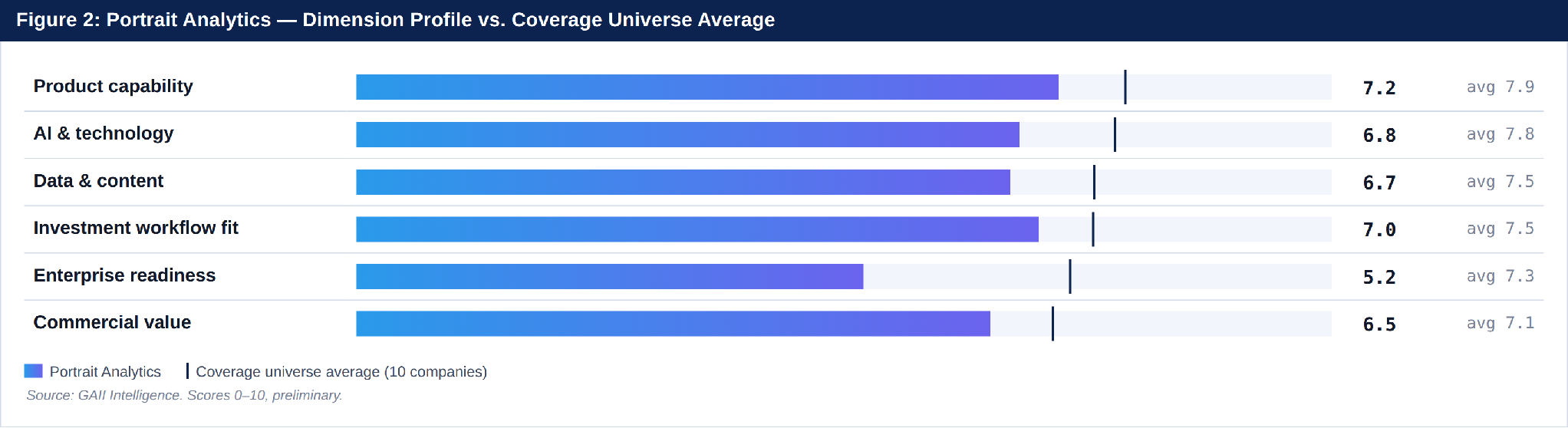
This dimension carries the lowest score in our assessment, and the reason is evidentiary rather than a finding of deficiency. During our public review we were unable to locate documentation for a number of items that institutional buyers typically require. Figure 4 records exactly what we looked for and what we found, so that a prospective client can direct the conversation efficiently rather than starting from a blank page.
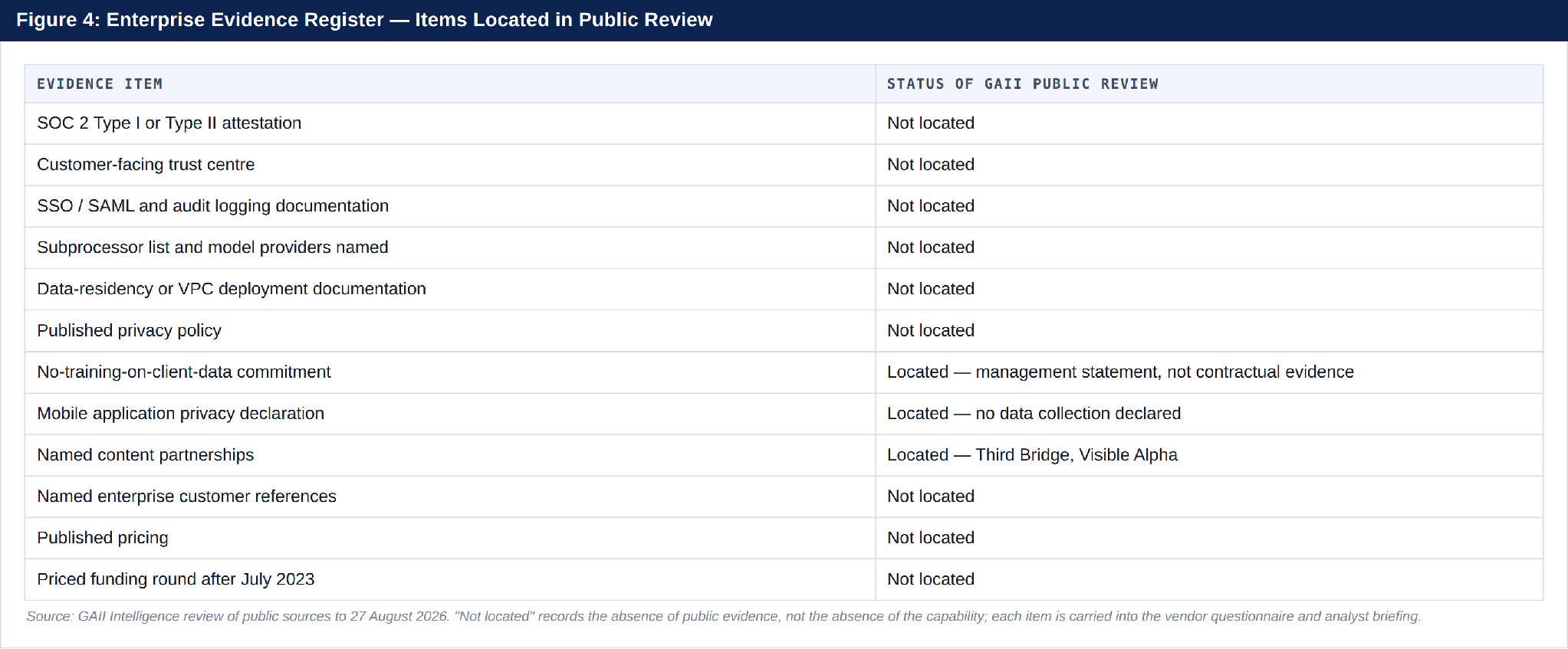
We would encourage any firm evaluating Portrait to raise these items with the company and to assess whether each can be accommodated. Several vendors of comparable size in our coverage have obtained attestation within twelve to eighteen months of first raising institutional capital, and the absence of published material at this stage is common rather than exceptional. What matters for a buyer is the timetable and the willingness to commit to it contractually.
The offsetting factors are real. Management states that client data is not used for training. The mobile application's store privacy declaration reports no data collection. Support is delivered directly by former analysts, and at this company size that is a service level a larger vendor cannot match; we scored it accordingly. Vendor viability is discussed in Section 3.
Commercial Model
Portrait does not publish pricing. The model has two tiers: a seat-based core platform sold to analysts, and the "Intelligence" tier sold to the portfolio manager or chief investment officer at a reported four to five times the core entry price. A full-access one-week trial with onboarding is available, which is a lower-friction evaluation path than most of the coverage universe offers.
The value argument the company makes is that the purchase substitutes for a junior analyst rather than adding an AI line item. That is the right frame for this buyer, and it lands against a budget line that already exists. What is not yet available is evidence: we did not locate a published return-on-investment study, an hours-saved measurement, a named reference, or retention disclosure. Together with the expert-network passthrough discussed in Section 7, this means a prospective client should model total cost of ownership rather than licence cost alone.
Competitive Position
Portrait sits in the Emerging quadrant of the GAII Intelligence Matrix: above-average utility to the investment process, delivered on a platform base that is still developing. Quadrant definitions are set out in Appendix B.
| COMPANY | SCORE | RATING | OUTLOOK | MATRIX QUADRANT |
| Rogo | 8.2 | Strong | Improving | Leaders |
| Hebbia | 8.1 | Strong | Stable | Leaders |
| Samaya AI | 8.0 | Strong | Improving | Leaders |
| Daloopa | 7.8 | Strong | Improving | Established Solutions |
| Endex | 7.8 | Strong | Stable | Leaders |
| LinqAlpha | 7.6 | Strong | Improving | Leaders |
| Finster AI | 7.4 | Established | Improving | Innovators |
| Hudson Labs | 7.1 | Established | Stable | Emerging |
| Brightwave | 7.0 | Established | Under Evaluation | Emerging |
| Portrait Analytics | 6.6 | Established | Under Evaluation | Emerging |
GAII initiation universe, 27 August 2026. Scores are preliminary and based on public information, pending vendor questionnaire and analyst briefing.
11.1 Where Portrait is strongest relative to peers
- Against the large document-analysis platforms, on the shape of the buy-side workflow — specifically the persistent thesis object, which we have not found elsewhere.
- Against content platforms, on opinionation: the product proposes an argument rather than returning a set of documents for the analyst to drive.
- Against general-purpose assistants, on citation traceability and evaluation discipline, which is the company's own stated competitive target.
11.2 Areas of narrower functional focus
Portrait has deliberately built depth in a specific part of the process rather than breadth across all of it. Prospective clients should understand where that leaves gaps relative to alternatives.
- Modelling and quantitative work: not addressed; other vendors in the universe operate directly on the spreadsheet or the model.
- Content breadth: no broker research, and expert content is licensed rather than owned.
- Surface coverage: no spreadsheet, Office, research-management-system or documented API access at present.
- Procurement evidence: less published security and deployment documentation than several peers of similar or smaller size.
Score Summary
Scores are on a 0–10 scale. Each dimension score is the mean of its sub-criteria, and the GAII Overall Score is the weighted mean of the six dimensions. The detailed sub-criteria scores that build each dimension are set out in Appendix A.
| DIMENSION | WEIGHT | SCORE | ASSESSMENT |
| 1. Product Capability | 20% | 7.2 | Well-shaped for the buy-side process; narrower on deliverable output and modelling. |
| 2. AI & Technology | 20% | 6.8 | Sound agentic architecture; model strategy and evaluation not yet publicly disclosed. |
| 3. Data & Content | 17.5% | 6.7 | Strong public content and expert access; no broker research; content licensed rather than owned. |
| 4. Investment Workflow Fit | 17.5% | 7.0 | Leading on idea generation and monitoring; delivery surfaces still to come. |
| 5. Enterprise Readiness | 15% | 5.2 | Reflects the absence of located public evidence; see Figure 4 and Section 13. |
| 6. Commercial Value | 10% | 6.5 | Credible substitution case and easy evaluation; pricing and ROI evidence not published. |
| GAII OVERALL SCORE | 100% | 6.6 | Established | Outlook: Under Evaluation | Matrix: Emerging |
Open Questions
These are the areas where our public review did not find sufficient evidence to form a settled view. We have put them to the company and will update this note when they are answered. Prospective clients may find them a useful agenda for their own evaluation call.
- Confirmation of the current chief executive and the date and circumstances of any transition.
- Whether capital has been raised since July 2023, and what protections the company can offer clients entering multi-year agreements.
- The status and expected timetable for a SOC 2 attestation, a trust centre, single sign-on, audit logging, a subprocessor list and a data-residency policy.
- Which model providers are used, and whether zero-data-retention terms are in place with each.
- Whether private-cloud or single-tenant deployment is available, and what "ring-fenced" denotes in the Intelligence tier.
- Price points for the core platform and the Intelligence tier, contract minimums and term.
- Retention metrics, the proportion of the approximately 100 firms that are paying, and reconciliation of the "80+ funds" and "approximately 100 firms" figures.
- The largest single deployment by seats, and the typical path from pilot to firmwide adoption.
- The plan, if any, for broker and sell-side research entitlements.
- Delivery timing for research-management-system connectivity, private-company data, a spreadsheet integration and a public API.
- Current engineering leadership.
- The evaluation methodology and any accuracy results the company is able to share.
- Two customer references available for diligence conversations under non-disclosure.
Context — How To Use This Research
This note is an assessment of a vendor against a defined framework, not a recommendation to buy or to decline. The following are the considerations we would put at the centre of an evaluation of Portrait specifically.
If you are a fundamental equity manager
- Run the one-week trial against live coverage rather than a demonstration ticker, and judge Idea Search and Thesis Monitors on names your team already knows well.
- Establish where the product sits in the daily workflow given that it does not currently appear in the spreadsheet or the research management system.
- Model total cost of ownership including any expert-network subscription the integration requires.
If you are responsible for technology or vendor risk
- Open the conversation with Figure 4 and ask for a timetable against each item rather than a yes or no.
- Ask for the model provider list and the contractual basis of the no-training commitment, including terms held with model vendors.
- Discuss data egress on termination and business continuity, proportionate to the size of the commitment.
If you are assessing the category rather than the company
- Persistent thesis monitoring is, on our current evidence, the most differentiated capability in this market and the one we would expect larger vendors to build next.
- Published evaluation methodology is becoming a point of competitive separation; vendors that disclose it are likely to gain in procurement.
- Delivery surface — spreadsheet, Office, research management system — is where we expect the next round of competition to be decided.
Appendix A — Sub-criteria Detail
Each dimension score in Section 12 is the mean of the sub-criteria below.
| DIMENSION | SUB-CRITERION | SCORE |
| Product Capability | Workflow breadth | 7.0 |
| Output quality (analyst-grade) | 7.5 | |
| Agentic autonomy and task horizon | 7.5 | |
| Usability and time-to-value | 7.5 | |
| Deliverable fidelity (model, deck, memo) | 5.5 | |
| Configurability to firm framework | 8.0 | |
| AI & Technology | Model strategy and provider dependency | 6.0 |
| Retrieval and reasoning architecture | 7.5 | |
| Citation fidelity and control of unsupported claims | 7.0 | |
| Published evaluation evidence | 5.5 | |
| Engineering depth | 7.5 | |
| Shipping velocity | 7.0 | |
| Data & Content | Filings and transcripts | 8.0 |
| Expert-network content | 7.5 | |
| Broker and sell-side research | 3.0 | |
| Consensus and estimates | 7.0 | |
| Client-proprietary ingestion | 7.0 | |
| Coverage breadth and source auditability | 7.5 | |
| Investment Workflow Fit | Buy-side native design | 9.0 |
| Idea generation | 8.5 | |
| Thesis monitoring and persistence | 8.5 | |
| Modelling and quantitative workflow | 4.5 | |
| Delivery surfaces (spreadsheet, RMS, messaging) | 4.0 | |
| Adoption support and change management | 7.5 | |
| Enterprise Readiness | Security certification evidence | 3.0 |
| Deployment options | 4.5 | |
| Data governance and no-training commitments | 6.5 | |
| Access control, single sign-on, audit logging | 4.0 | |
| Compliance and information-barrier controls | 5.0 | |
| Vendor viability and scale | 4.5 | |
| Support and service model | 9.0 | |
| Commercial Value | Price transparency | 4.0 |
| Total cost of ownership | 5.5 | |
| Value against the alternative | 8.5 | |
| Contract flexibility and trial | 8.0 | |
| Documented return-on-investment evidence | 5.5 | |
| Pricing-model alignment | 7.5 |
Methodology
The GAII Intelligence Framework scores every company in coverage on six dimensions, each built from sub-criteria. Evidence is weighted in descending order: verifiable primary evidence such as attestations, contracts, published documentation and named references; then the company's completed GAII questionnaire and analyst briefing; then public secondary sources. Claims that cannot be corroborated are recorded as company-reported and do not raise a score.
| 1. Product Capability | 20% | What the product does: workflow breadth, output quality, agentic autonomy, usability, fidelity of deliverables, configurability. |
| 2. AI & Technology | 20% | How it is built: model strategy and provider dependency, retrieval and reasoning, citation fidelity, published evaluation, engineering depth, shipping velocity. |
| 3. Data & Content | 17.5% | What it knows: filings and transcripts, expert content, broker research, consensus data, client-material ingestion, coverage and auditability. |
| 4. Investment Workflow Fit | 17.5% | How it fits the process: buy-side design, idea generation, monitoring, modelling, delivery surfaces, adoption support. |
| 5. Enterprise Readiness | 15% | Whether it can be bought: certifications, deployment, data governance, access control, compliance, vendor viability, support. |
| 6. Commercial Value | 10% | Whether it is worth it: price transparency, total cost of ownership, value against the alternative, contract flexibility, return evidence, pricing alignment. |
Rating bands
| 8.5 – 10.0 | Leader | Category-defining capability with the platform maturity to support standardisation across a firm. |
| 7.5 – 8.4 | Strong | Suitable for enterprise deployment following normal diligence. |
| 6.5 – 7.4 | Established | Credible for targeted deployment, with specific areas to clarify during evaluation. |
| 5.5 – 6.4 | Emerging | Well suited to pilot deployment while particular capabilities continue to develop. |
| Below 5.5 | Specialist | Deliberately narrow functional focus, or areas we are still evaluating. |
Outlook definitions: Improving — we expect the overall score to rise at the next review on evidence already visible. Stable — no directional change expected within two review cycles. Softening — we expect the score to decline on competitive, commercial or execution evidence. Under Evaluation — material questions remain open; the score may move in either direction once they are resolved.
Matrix construction: Investment Utility (horizontal) = Product Capability × 0.40 + Data & Content × 0.30 + Investment Workflow Fit × 0.30. Market & Innovation Strength (vertical) = AI & Technology × 0.40 + Enterprise Readiness × 0.35 + Momentum × 0.25, where Momentum is a separate 0–10 assessment of capital position, traction, growth and strategic backing. Quadrant boundaries sit at 7.50 on both axes for the current cohort and are restated at each quarterly review.
Relationship Disclosure
GAII Institute organises the annual Generative AI in Investment Management conference, at which companies covered in this universe may appear as speakers, exhibitors or sponsors. As at the date of this note, GAII Institute has had no compensated relationship with Portrait Analytics, Inc. Any such relationship arising in future will be disclosed in this section.
Important Disclosures
Copyright and distribution. © 2026 GAII Institute. All rights reserved. GAII Intelligence and GAII Intelligence Matrix are marks of GAII Institute. This publication is licensed to the named recipient and may not be reproduced, redistributed, republished, posted, transmitted or made available to any other person, in whole or in part, in any form or by any means, without the prior written permission of GAII Institute.
Nature of this publication. This publication consists of the opinions of the GAII Intelligence research team as at the date shown and is subject to change without notice. It should not be construed as a statement of fact. While the information contained in it has been obtained from sources believed to be reliable, GAII Institute disclaims all warranties, express or implied, as to the accuracy, completeness or adequacy of that information. Ratings and scores are analytical opinions and are not a guarantee of any vendor's performance, viability or suitability.
Not investment, legal or procurement advice. Although GAII Intelligence research may address commercial, legal and financial matters, GAII Institute does not provide investment, legal or accounting advice, and this publication should not be construed or used as such. It is not a recommendation to buy, sell or hold any security or private interest, and it is not a substitute for the reader's own evaluation, diligence and procurement process.
Independence and objectivity. GAII Intelligence ratings are not for sale. No fee, sponsorship, membership, conference participation or other commercial relationship influences a rating, a score or a position on the GAII Intelligence Matrix, and analysts are not compensated on the basis of vendor relationships. Covered companies receive a factual-accuracy review before publication; they may correct factual errors and may not alter analysis, scores or wording.
Use in artificial intelligence systems. This publication may not be used as input into, or for the training, fine-tuning or development of, any generative artificial intelligence model, machine learning system, algorithm, software or related technology.
Log in as a member to download the full report.