
Pinegap: Initiation of Coverage
Market Definition
GAII Intelligence defines the AI Research & Intelligence market as software that applies generative and agentic AI to the research process of professional investors: locating candidate securities, assembling and interrogating evidence, producing written analysis with traceable sources, and monitoring positions once held. Buyers are hedge funds, long-only managers, multi-manager platforms, family offices and allocators; the economic buyer is typically the chief technology officer, the head of research, or a portfolio manager with a technology budget.
Capabilities we treat as mandatory
- Evidence retrieval at scale: the ability to search and reason across regulatory filings, transcripts and news, and across documents the client supplies.
- Source traceability: every material claim in an output must be reachable back to the passage that supports it.
- Institutional data handling: a stated position on where client data goes, how long it is held, and whether it is used for model training.
Capabilities we treat as differentiating
- Persistent state: the system remembers a thesis, a coverage list or a position between sessions and acts on it without being re-prompted.
- Workflow surfaces: delivery inside the applications analysts already use — the spreadsheet, the research management system, email and messaging.
- Owned or exclusive content: material that a competitor cannot obtain by signing the same third-party contract.
- Published evaluation: a measured, disclosed accuracy methodology rather than an assertion of quality.
Pinegap competes with Pinegap for proactive thesis monitoring, with Hudson Labs on proxy and forensic review, and more broadly with Hebbia, Rogo and AlphaSense. Its push model and fund-letter and social coverage are its distinguishing features.
Strengths
The following are the capabilities and characteristics that, in our assessment, most distinguish Pinegap within the AI Research & Intelligence market. Each is drawn from publicly documented product capability, published interviews with management, or independent hands-on review.
- Analyst design: Modules mirror a long/short analyst's routine — primer, earnings, conferences, proxy, risk and thesis tracking.
- Push agents: Scheduled and event-triggered output delivered to the analyst's inbox.
- Distribution: A verified Claude connector (June 2026) and MCP access from ChatGPT, Microsoft Copilot, Gemini and Cursor.
- Coverage beyond filings: Podcasts, X, Reddit, Substack and fund letters alongside filings and transcripts for 25,000+ companies.
- Traction claims: 100+ institutional clients and five of the top ten New York multi-managers (company).
- Disclosed model providers: OpenAI and Azure OpenAI with a Google fallback, named in policy.
Cautions
The following are factors that prospective clients should weigh, and areas where our public review did not find sufficient evidence to reach a settled view. Several are common across vendors at this stage of the market and are not specific to Pinegap. We encourage prospective clients to raise each of them directly with the company; we have done the same, and will update this note as answers arrive.
- Security evidence: "SOC 2 compliance" is claimed without type, auditor or date; ISO 27001, SCIM, customer audit logs and residency options were not located.
- Compliance controls: MNPI and information-barrier controls were not located.
- Downstream training: Pinegap's no-training pledge does not address the model providers it uses.
- Content scope: No expert, broker or consensus data, and data providers are not named.
- Evaluation: No evaluation or citation controls were located.
- Inconsistent figures: Client counts ("100+ institutions" and "250+ funds"), headcount and report volumes differ across sources.
- Pricing and scale: No public pricing, and a team of about 20.
Company Profile
Pinegap Inc. is based at 14 Penn Plaza, New York, with engineering in Bengaluru. It was founded in 2024 by Deepak Sharma (CEO), an IIT-BHU engineer, and Ankit Varmani (CBO), who reports 15 years on the sell side and buy side including J.P. Morgan equity research. Commercial launch followed in the first quarter of 2025.
Pinegap raised a $2.5m seed in April 2024 led by SVQuad and Inventus Capital with DeVC, and an $8m Series A in August 2026 led by Stellaris Venture Partners — $10.5m in total. The company says the Series A valuation was more than triple the seed and that ARR doubled after launch; neither figure is disclosed.

| Legal entity | Pinegap Inc. |
| Founded | 2024 |
| Founders | Deepak Sharma (CEO); Ankit Varmani (CBO) |
| Headquarters | New York, NY; engineering in Bengaluru |
| Headcount | ~13–21 (sources differ) |
| Disclosed funding | $10.5m: seed $2.5m (SVQuad, Inventus); Series A $8m (Stellaris) |
| Valuation | Not disclosed |
| Revenue | Not disclosed |
| Clients | 100+ institutions (company); 250+ funds (pricing page) |
| Coverage | 25,000+ companies |
| AI distribution | Claude connector; ChatGPT; Microsoft Copilot |
| Model providers | OpenAI, Azure OpenAI; Google fallback |
Company-reported figures are shown as such and are not independently verified. Verification is carried into the vendor questionnaire.
Product and Capabilities
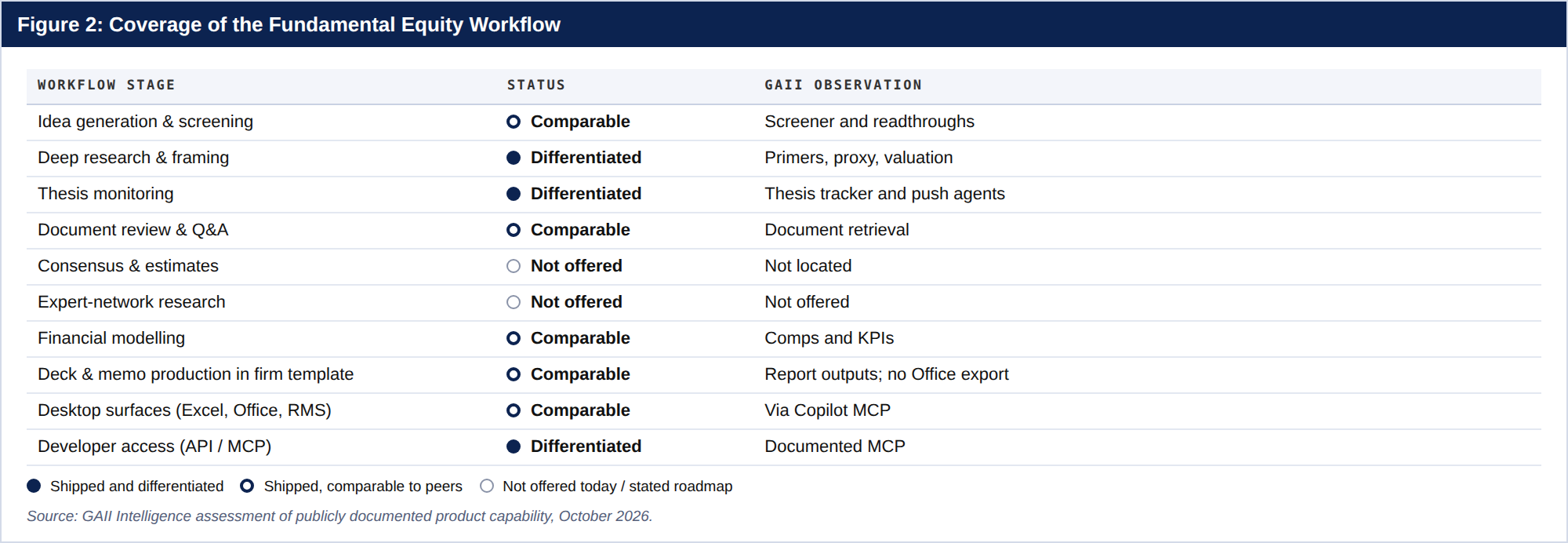
Pinegap offers analyst workflow modules and push agents. Figure 2 sets out our assessment of how it maps onto the investment workflow.
Company modules
Overview, primer, valuation, proxy review, risk tracker and peer comparisons.
Earnings and conferences
Previews, recaps, guidance, sentiment, readthroughs and follow-up questions.
Thesis and push agents
Thesis tracker, watchlists and agents delivering scheduled or event-driven output.
MCP connector
About 32 tools via OAuth, verified in Claude and available in ChatGPT and Copilot.
Scope of the product today
We did not locate an Excel or Office add-in, expert or broker content, or public pricing.
AI and Technology
Pinegap uses OpenAI and Azure OpenAI as primary models, Google as fallback and Perplexity for web search, according to its MCP privacy policy. A proprietary model described in 2024 has no current trace.
No evaluation results or citation controls were located.
Data and Content
Content covers 25,000+ companies: SEC filings, transcripts, press releases, conferences, podcasts, X, Reddit, Substack, fund letters, short interest and quotes, with market data from an unnamed provider.
Expert, broker and consensus data were not located. Clients can connect their own data.
Investment Workflow Fit
Pinegap fits the monitoring and ramp-up stages of a fundamental analyst's work: preparing primers and earnings reviews and tracking theses.
Modelling and deliverable production are limited.
Enterprise Readiness
Pinegap claims SOC 2 compliance and enterprise SSO, uses OAuth 2.1 for its connector, runs on AWS US regions and publishes retention periods and its own no-training pledge. Figure 3 sets out what our public review located.
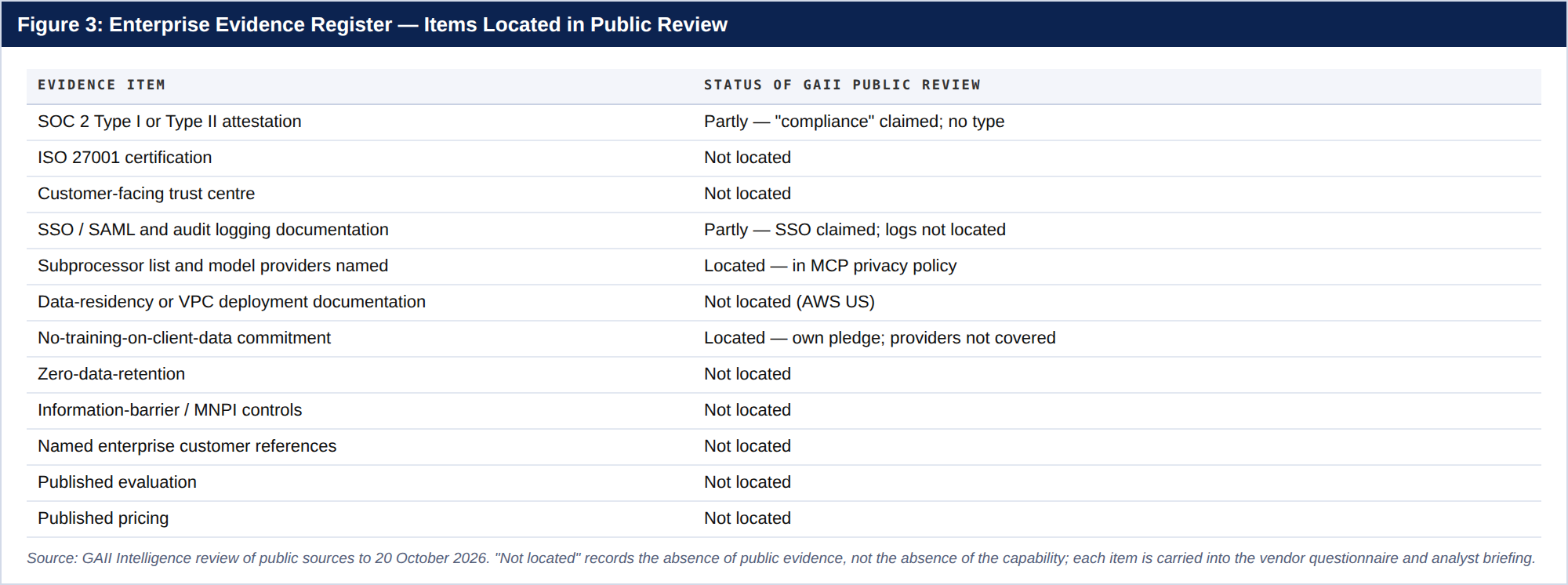
We would encourage buyers to request the SOC 2 report, SCIM and audit logs, model-provider retention terms and MNPI controls.
The offsetting factor is disclosure of model providers and retention periods, which several larger peers do not publish.
Commercial Model
Pricing is not published; subscriptions are seat-based, with a two-week trial on request.
Buyers should compare cost against Pinegap and larger platforms.
Competitive Position
Pinegap sits in the Emerging quadrant of the GAII Intelligence Matrix, below the Emerging band on overall score, held back by missing evidence.
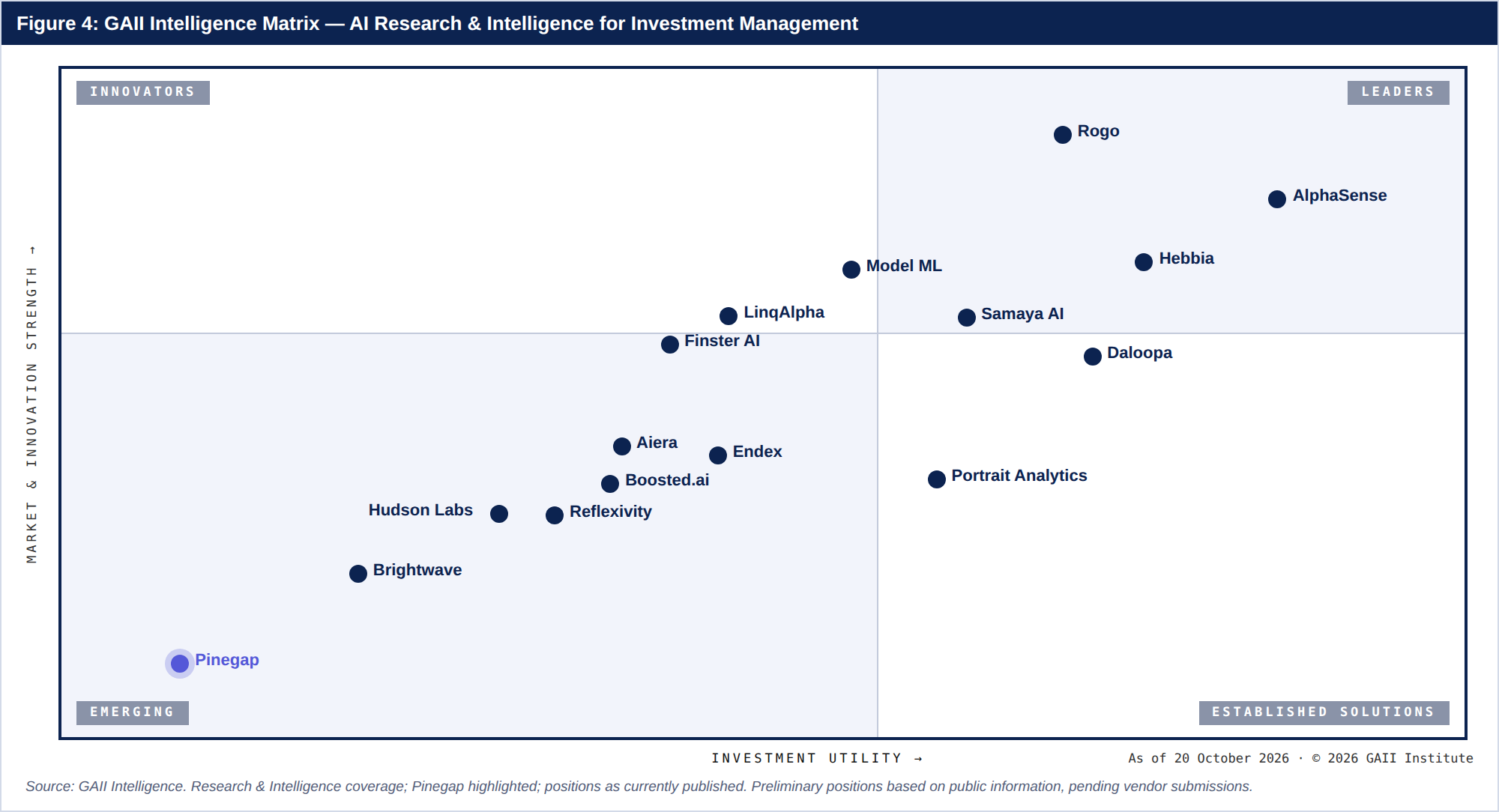
| COMPANY | SCORE | RATING | OUTLOOK | MATRIX QUADRANT |
| Rogo | 8.20 | Strong | Improving | Leaders |
| AlphaSense | 8.19 | Strong | Improving | Leaders |
| Hebbia | 8.10 | Strong | Stable | Leaders |
| Daloopa | 7.80 | Strong | Improving | Established Solutions |
| Samaya AI | 7.50 | Strong | Improving | Leaders |
| Model ML | 7.30 | Established | Improving | Innovators |
| LinqAlpha | 7.11 | Established | Improving | Innovators |
| Portrait Analytics | 7.05 | Established | Improving | Established Solutions |
| Finster AI | 6.83 | Established | Improving | Emerging |
| Endex | 6.72 | Established | Stable | Emerging |
| Hudson Labs | 6.70 | Established | Stable | Emerging |
| Boosted.ai | 6.69 | Established | Stable | Emerging |
| Aiera | 6.62 | Established | Under Evaluation | Emerging |
| Reflexivity | 6.50 | Established | Stable | Emerging |
| Brightwave | 6.21 | Emerging | Softening | Emerging |
| Pinegap | 5.23 | Watch | Improving | Emerging |
GAII initiation universe, 20 October 2026. Scores as currently published on the GAII Intelligence page; preliminary and based on public information.
11.1 Where Pinegap is strongest relative to peers
- Against chat-based copilots, on push agents.
- Against larger platforms, on analyst-specific modules.
- Against peers, on social and fund-letter coverage.
11.2 Areas of narrower functional focus
Pinegap has built depth in analyst workflow rather than content or documentation.
- Enterprise: attestation unverified.
- Content: no premium content.
- Evidence: no evaluation or pricing.
- Scale: about 20 staff.
Score Summary
Scores are on a 0–10 scale. Each dimension score is the mean of its sub-criteria, and the GAII Overall Score is the weighted mean of the six dimensions. The detailed sub-criteria scores that build each dimension are set out in Appendix A.
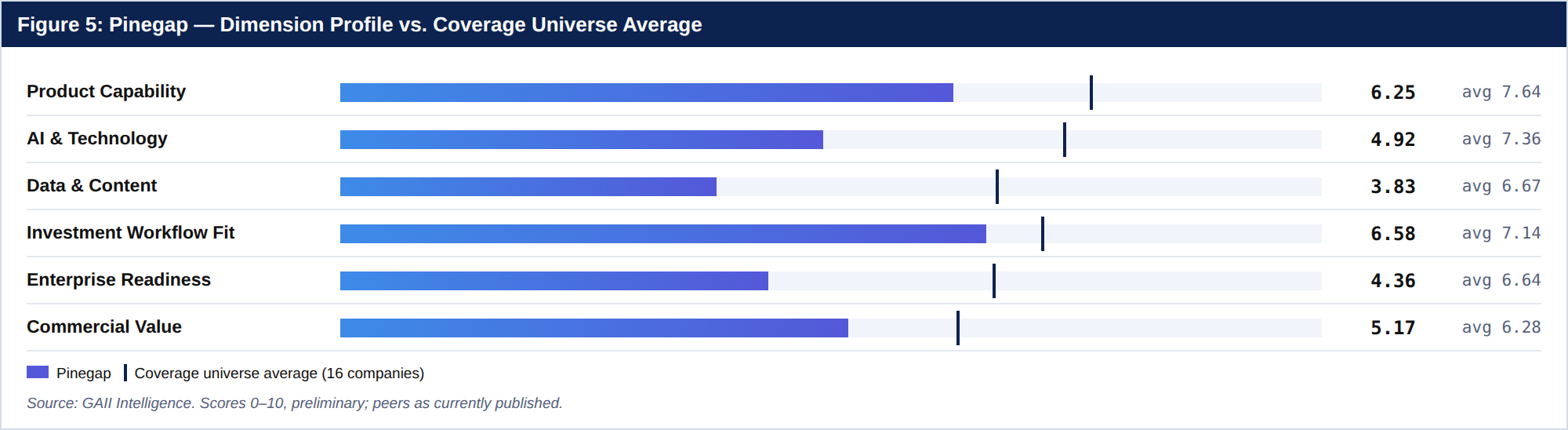
| DIMENSION | WEIGHT | SCORE | ASSESSMENT |
| 1. Product Capability | 20% | 6.25 | Broad analyst modules; limited exports. |
| 2. AI & Technology | 20% | 4.92 | Providers disclosed; no evaluation. |
| 3. Data & Content | 17.5% | 3.83 | Filings and alternative sources; no premium content. |
| 4. Investment Workflow Fit | 17.5% | 6.58 | Strongest: monitoring and analyst design. |
| 5. Enterprise Readiness | 15% | 4.36 | Documentation largely not located. |
| 6. Commercial Value | 10% | 5.17 | No pricing. |
| GAII OVERALL SCORE | 100% | 5.23 | Niche/Watch; Emerging quadrant. |
Open Questions
These are the areas where our public review did not find sufficient evidence to form a settled view. We have put them to the company and will update this note when they are answered. Prospective clients may find them a useful agenda for their own evaluation call.
- The SOC 2 report type and period.
- SCIM and customer audit logs.
- Retention and training terms with model providers.
- MNPI and information-barrier controls.
- Named data providers.
- Citation controls.
- Evaluation results.
- Pricing.
- Reconciliation of client counts.
- Named references.
- Excel or Office export plans.
- Current headcount.
Context — How To Use This Research
This note is an assessment of a vendor against a defined framework, not a recommendation to buy or to decline. The following are the considerations we would put at the centre of an evaluation of Pinegap specifically.
If you are a fundamental equity manager
- Trial the push agents on your watchlist.
- Compare with Pinegap.
- Check transcript and filing sources.
If you are responsible for technology or vendor risk
- Open with Figure 3; request the SOC 2 report.
- Confirm model-provider terms.
- Assess support capacity.
If you are assessing the category rather than the company
- Push agents are replacing prompt-based research.
- MCP distribution lets small vendors reach large firms.
- Evidence, not features, separates early vendors.
Appendix A — Sub-criteria Detail
Each dimension score in Section 12 is the mean of the sub-criteria below.
| DIMENSION | SUB-CRITERION | SCORE |
| Product Capability | Workflow breadth | 7.0 |
| Output quality (analyst-grade) | 5.5 | |
| Agentic autonomy and task horizon | 7.5 | |
| Usability and time-to-value | 7.0 | |
| Deliverable fidelity (model, deck, memo) | 4.0 | |
| Configurability to firm framework | 6.5 | |
| AI & Technology | Model strategy and provider dependency | 5.5 |
| Retrieval and reasoning architecture | 5.0 | |
| Citation fidelity and control of unsupported claims | 4.0 | |
| Published evaluation evidence | 2.0 | |
| Engineering depth | 5.5 | |
| Shipping velocity | 7.5 | |
| Data & Content | Filings and transcripts | 7.0 |
| Expert-network content | 1.5 | |
| Broker and sell-side research | 1.5 | |
| Consensus and estimates | 2.0 | |
| Client-proprietary ingestion | 5.0 | |
| Coverage breadth and source auditability | 6.0 | |
| Investment Workflow Fit | Buy-side native design | 8.5 |
| Idea generation | 5.5 | |
| Thesis monitoring and persistence | 8.5 | |
| Modelling and quantitative workflow | 3.5 | |
| Delivery surfaces (spreadsheet, RMS, messaging) | 7.5 | |
| Adoption support and change management | 6.0 | |
| Enterprise Readiness | Security certification evidence | 4.0 |
| Deployment options | 3.5 | |
| Data governance and no-training commitments | 5.5 | |
| Access control, single sign-on, audit logging | 4.5 | |
| Compliance and information-barrier controls | 2.5 | |
| Vendor viability and scale | 5.5 | |
| Support and service model | 5.0 | |
| Commercial Value | Price transparency | 2.5 |
| Total cost of ownership | 6.0 | |
| Value against the alternative | 6.5 | |
| Contract flexibility and trial | 6.5 | |
| Documented return-on-investment evidence | 3.0 | |
| Pricing-model alignment | 6.5 |
Methodology
The GAII Intelligence Framework scores every company in coverage on six dimensions, each built from sub-criteria. Evidence is weighted in descending order: verifiable primary evidence such as attestations, contracts, published documentation and named references; then the company's completed GAII questionnaire and analyst briefing; then public secondary sources. Claims that cannot be corroborated are recorded as company-reported and do not raise a score.
| 1. Product Capability | 20% | What the product does: workflow breadth, output quality, agentic autonomy, usability, fidelity of deliverables, configurability. |
| 2. AI & Technology | 20% | How it is built: model strategy and provider dependency, retrieval and reasoning, citation fidelity, published evaluation, engineering depth, shipping velocity. |
| 3. Data & Content | 17.5% | What it knows: filings and transcripts, expert content, broker research, consensus data, client-material ingestion, coverage and auditability. |
| 4. Investment Workflow Fit | 17.5% | How it fits the process: buy-side design, idea generation, monitoring, modelling, delivery surfaces, adoption support. |
| 5. Enterprise Readiness | 15% | Whether it can be bought: certifications, deployment, data governance, access control, compliance, vendor viability, support. |
| 6. Commercial Value | 10% | Whether it is worth it: price transparency, total cost of ownership, value against the alternative, contract flexibility, return evidence, pricing alignment. |
Rating bands
| 8.5 – 10.0 | Leader | Category-defining capability with the platform maturity to support standardisation across a firm. |
| 7.5 – 8.4 | Strong | Suitable for enterprise deployment following normal diligence. |
| 6.5 – 7.4 | Established | Credible for targeted deployment, with specific areas to clarify during evaluation. |
| 5.5 – 6.4 | Emerging | Well suited to pilot deployment while particular capabilities continue to develop. |
| Below 5.5 | Specialist | Deliberately narrow functional focus, or areas we are still evaluating. |
Outlook definitions: Improving — we expect the overall score to rise at the next review on evidence already visible. Stable — no directional change expected within two review cycles. Softening — we expect the score to decline on competitive, commercial or execution evidence. Under Evaluation — material questions remain open; the score may move in either direction once they are resolved.
Matrix construction: Investment Utility (horizontal) = Product Capability × 0.40 + Data & Content × 0.30 + Investment Workflow Fit × 0.30. Market & Innovation Strength (vertical) = AI & Technology × 0.40 + Enterprise Readiness × 0.35 + Momentum × 0.25, where Momentum is a separate 0–10 assessment of capital position, traction, growth and strategic backing. Quadrant boundaries sit at 7.50 on both axes for the current cohort and are restated at each quarterly review.
Relationship Disclosure
GAII Institute organises the annual Generative AI in Investment Management (GAIIM) conference. Pinegap's co-founder Ankit Varmani spoke at GAIIM 2025 and GAIIM 2026; Pinegap was not a sponsor. Under GAII Institute policy, conference relationships are managed separately from research and speakers receive no advance sight of ratings or notes.
Important Disclosures
Copyright and distribution. © 2026 GAII Institute. All rights reserved. GAII Intelligence and GAII Intelligence Matrix are marks of GAII Institute. This publication is licensed to the named recipient and may not be reproduced, redistributed, republished, posted, transmitted or made available to any other person, in whole or in part, in any form or by any means, without the prior written permission of GAII Institute.
Nature of this publication. This publication consists of the opinions of the GAII Intelligence research team as at the date shown and is subject to change without notice. It should not be construed as a statement of fact. While the information contained in it has been obtained from sources believed to be reliable, GAII Institute disclaims all warranties, express or implied, as to the accuracy, completeness or adequacy of that information. Ratings and scores are analytical opinions and are not a guarantee of any vendor's performance, viability or suitability.
Not investment, legal or procurement advice. Although GAII Intelligence research may address commercial, legal and financial matters, GAII Institute does not provide investment, legal or accounting advice, and this publication should not be construed or used as such. It is not a recommendation to buy, sell or hold any security or private interest, and it is not a substitute for the reader's own evaluation, diligence and procurement process.
Independence and objectivity. GAII Intelligence ratings are not for sale. No fee, sponsorship, membership, conference participation or other commercial relationship influences a rating, a score or a position on the GAII Intelligence Matrix, and analysts are not compensated on the basis of vendor relationships. Covered companies receive a factual-accuracy review before publication; they may correct factual errors and may not alter analysis, scores or wording.
Use in artificial intelligence systems. This publication may not be used as input into, or for the training, fine-tuning or development of, any generative artificial intelligence model, machine learning system, algorithm, software or related technology.
Log in as a member to download the full report.