
M Science: Initiation of Coverage
Market Definition
GAII Intelligence defines the Alternative Data & Data Infrastructure market as companies that supply investment firms with non-traditional evidence on company and economic performance — transaction, receipt, location, web and business-spend data — and the tools that collect, clean and deliver it. Buyers are heads of data strategy and data sourcing, fundamental and quantitative analysts, and the compliance teams who must approve each new source.
Capabilities we treat as mandatory
- Point-in-time integrity: history that can be tested without look-ahead, with restatements, panel changes and survivorship handled and disclosed.
- Provenance and screening: a documented chain from source to delivery, with consent, licensing, MNPI and personal-data screening a compliance team can review.
- Investable mapping: data resolved to tickers and entities, so that a signal can be tied to a security without manual work.
Capabilities we treat as differentiating
- Predictive-value evidence: published back tests or, better, independent studies showing that the data anticipates reported results.
- AI-ready delivery: data shares into Snowflake and Databricks, and MCP connections that let a client's AI assistant query the data under entitlement.
- Transparent AI answers: conversational tools that show the query, panel size and method behind each answer and decline unsupported questions.
- AI in the pipeline: models that find sources, map entities and repair collection, cutting the time from idea to usable dataset.
M Science competes with YipitData, Consumer Edge and Bloomberg Second Measure in transaction-based KPI data, with Visible Alpha and consensus providers in KPI estimates, and with Guidepoint and expert networks for sector research.
Strengths
The following are the capabilities and characteristics that, in our assessment, most distinguish M Science within the Alternative Data & Data Infrastructure market. Each is drawn from publicly documented product capability, company releases and documentation, or independent reporting.
- Point-in-time model: Change-data capture in the Unified Data Model supports point-in-time analysis, historical comparison and back-testing.
- Quant delivery: Snowflake Share, Databricks Delta Sharing, S3, API and more than 600 programmatic endpoints.
- AI-assistant delivery: An MCP server that carries analyst context into ChatGPT, Claude and in-house systems.
- KPI depth: More than 1,440 KPIs on over 1,400 companies across about 40 subsectors (company).
- Analyst research: Written company research and direct analyst engagement alongside the data.
- Continuity: Wholly owned by Jefferies, with research history back to 2002.
Cautions
The following are factors that prospective clients should weigh, and areas where our public review did not find sufficient evidence to reach a settled view. Several are common across vendors at this stage of the market and are not specific to M Science. We encourage prospective clients to raise each of them directly with the company; we have done the same, and will update this note as answers arrive.
- Assurance: We did not locate SOC 2, ISO 27001, SSO or audit-log documentation.
- AI terms: No AI-use, model-provider or no-training statement was located; buyers should request them before using the MCP server.
- Provenance: Source consent, MNPI and personal-data screening are not publicly documented.
- Panel disclosure: Panel sizes are not disclosed, and coverage figures differ between sources (250+ public companies in February 2026; 1,400+ companies today).
- Evidence: No published predictive-value study or quantified client case was located.
- Pricing: Not published; no trial located.
- Litigation history: A trade-secrets dispute with YipitData over hired staff was settled privately in 2025.
Company Profile
M Science traces to Majestic Research, founded in 2002, which ITG acquired in 2010 and Leucadia National (now Jefferies Financial Group) acquired in 2016, renaming it M Science. It is a wholly owned Jefferies subsidiary with offices in New York and Hong Kong, and has a data subsidiary, Sundial.
M Science does not report revenue or headcount separately. In January 2025 it appointed Spenser Marshall CIO with a focus on AI, and hired Cindy Floyd from GLG as Global Head of Sales and Robert Mohan from Wellington Management as Head of Account Services.

| Legal entity | M Science (Jefferies subsidiary) |
| Founded | 2002 (Majestic Research) |
| Ownership history | ITG (2010); Leucadia/Jefferies (2016) |
| Headquarters | New York; Hong Kong office |
| Headcount | Not disclosed |
| Owner | Jefferies Financial Group (NYSE: JEF) |
| CEO | Michael Marrale |
| Revenue | Not reported separately |
| Clients | Hedge funds, asset managers, corporates (unnamed) |
| Coverage | 1,400+ companies, 1,440+ KPIs, 500+ feeds (company) |
| Assurance | Not located publicly |
| Delivery | Snowflake, Databricks, S3, API, MCP |
Company-reported figures are shown as such and are not independently verified. Verification is carried into the vendor questionnaire.
Product and Capabilities
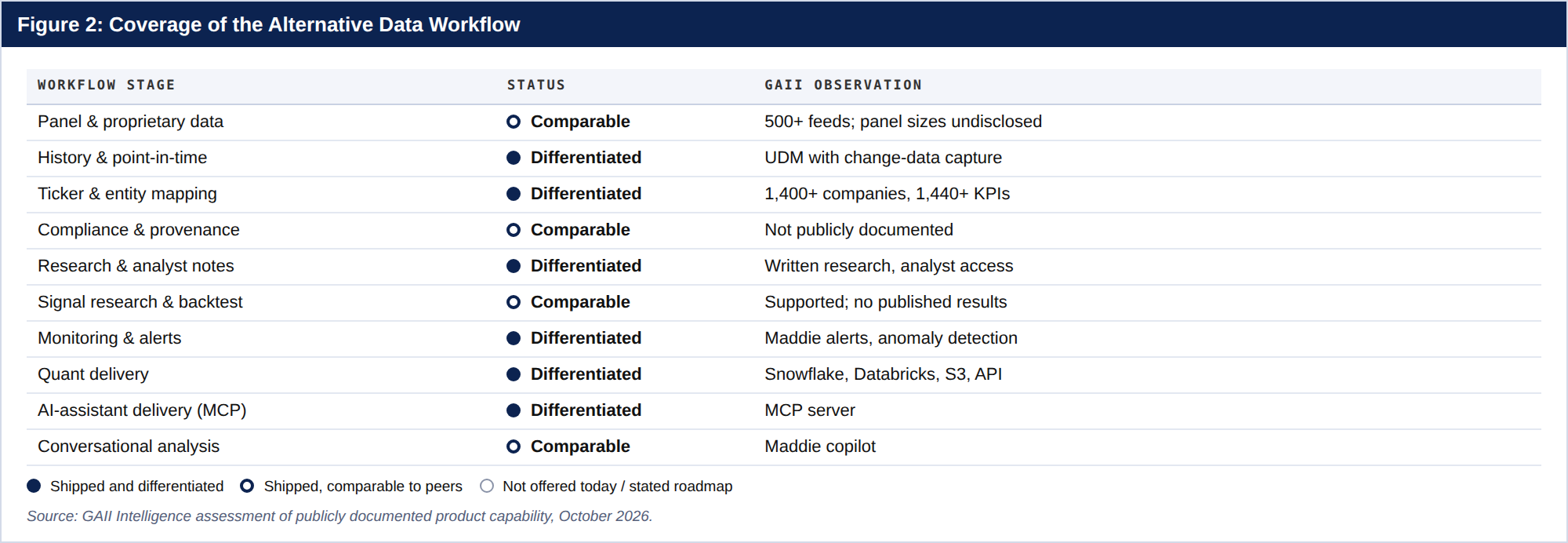
M Science sells data feeds and research by sector, now unified under one data model with AI access on top. Figure 2 sets out our assessment of how it maps onto the alternative data workflow.
Unified Data Model
Star-schema, point-in-time model for analyst-curated data (June 2026).
Data feeds and portal
Company, industry and KPI datasets with scheduled deliveries and discovery.
Maddie
Multi-agent copilot with benchmarking, charts, alerts and anomaly detection (February 2026).
MCP server and research
AI-assistant access to data and analyst-written research.
Scope of the product today
We did not locate a security attestation, AI-use terms, panel sizes, a source-screening programme or named client references.
AI and Technology
Maddie retrieves from M Science's reports and data through a semantic layer tuned to investment language and KPIs, and the MCP server reuses the same infrastructure.
Model providers are not named, AI in collection and mapping is not described, and no evaluation has been published.
Data and Content
M Science combines transaction, digital purchase, web traffic and technographic data into more than 500 analyst-curated feeds; the Unified Data Model adds point-in-time history and back-testing.
Panel sizes and source screening are not disclosed, which limits provenance scoring under this variant.
Investment Workflow Fit
M Science has the most complete quant delivery in the segment, with Snowflake, Databricks, S3, API and MCP, plus analyst research and KPI alerts.
Predictive-value evidence is the gap: the model supports back-testing, but no results have been published.
Enterprise Readiness
M Science publishes almost no enterprise evidence: no SOC 2, ISO 27001, SSO, audit-log or AI-use documentation was located. Figure 3 sets out what our public review located.
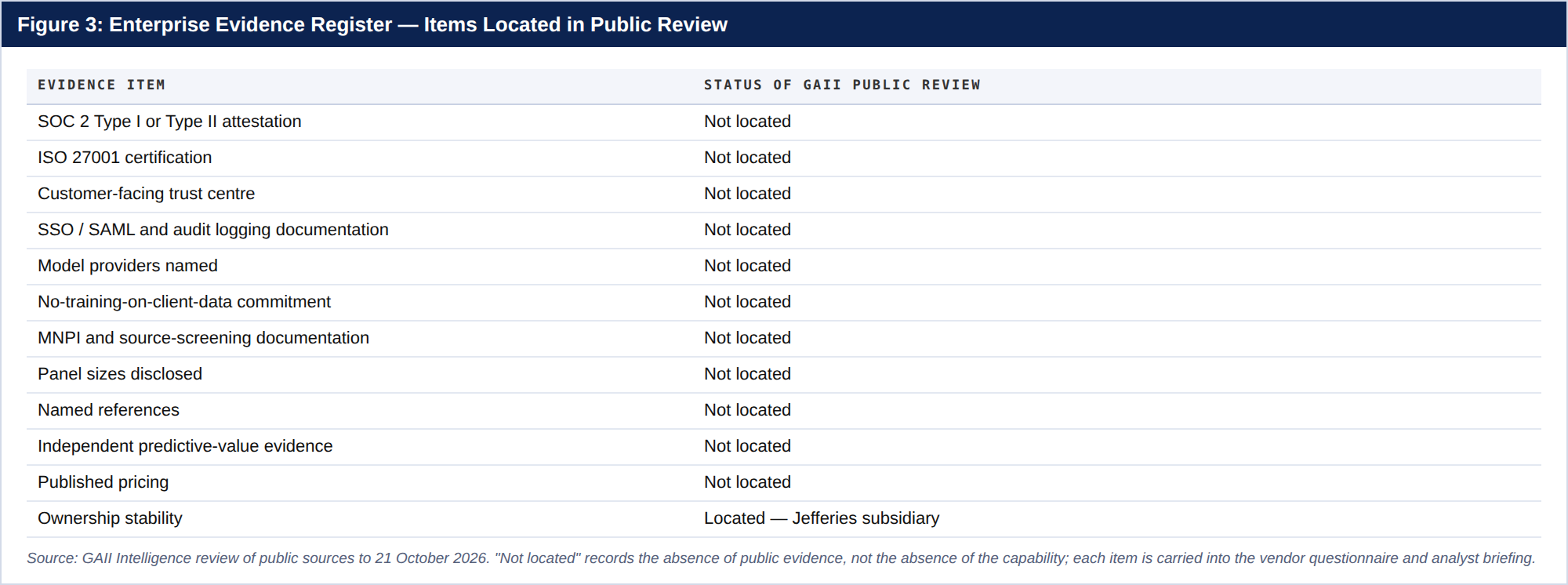
We would encourage buyers to request attestations, AI and model terms, and the source-screening process.
The offsetting factor is ownership: a Jefferies subsidiary with more than two decades of operating history.
Commercial Model
M Science does not publish pricing or trial terms; subscriptions are sold by sector and feed.
Buyers should ask for back-test results and quantified references before committing.
Competitive Position
M Science sits in the Emerging quadrant of the segment matrix, close to YipitData on Investment Utility but lower on Market & Innovation Strength because of Enterprise Readiness.
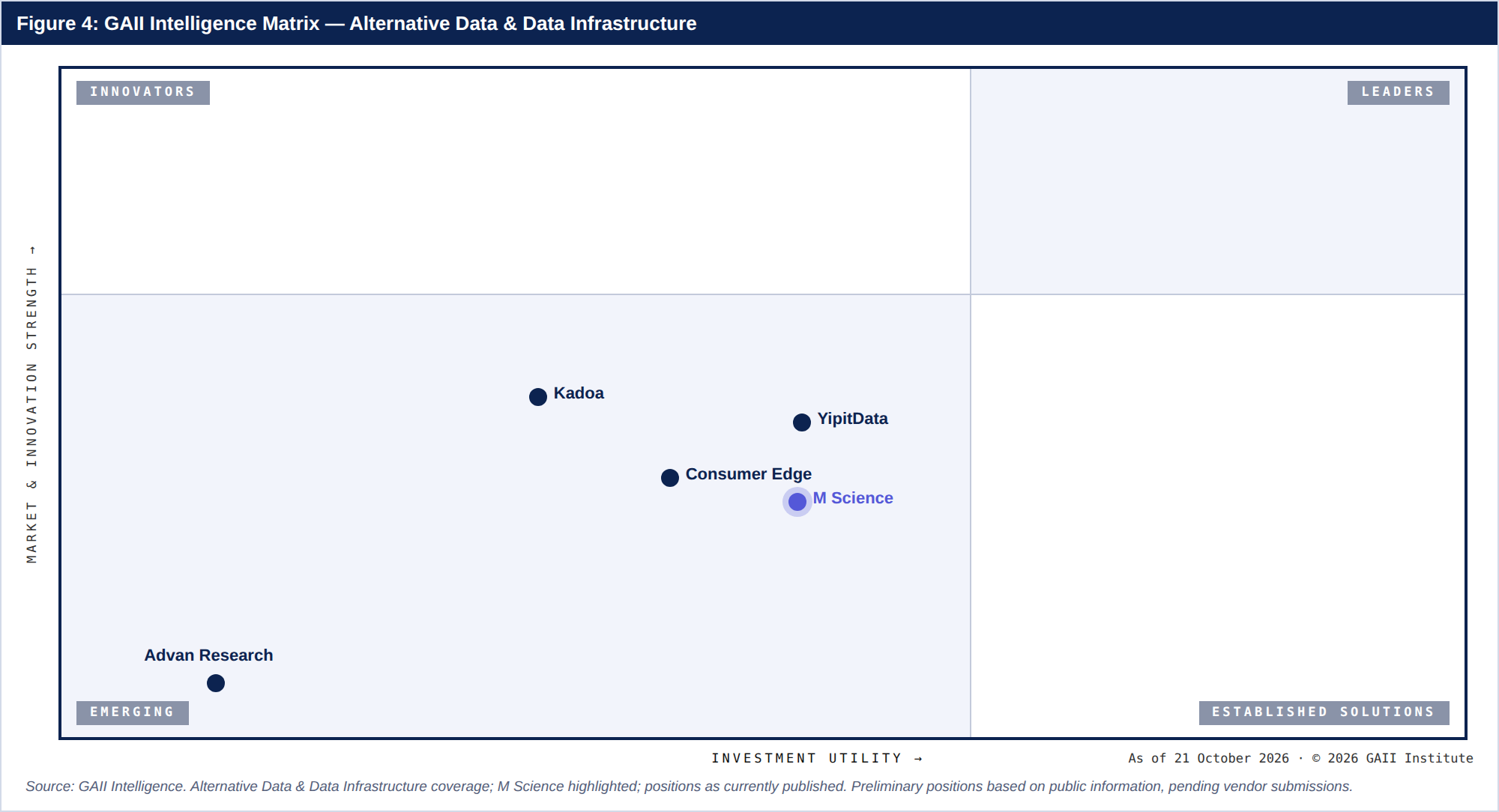
| COMPANY | SCORE | RATING | OUTLOOK | MATRIX QUADRANT |
| YipitData | 6.47 | Emerging | Under Evaluation | Emerging |
| Kadoa | 6.38 | Emerging | Improving | Emerging |
| M Science | 6.20 | Emerging | Improving | Emerging |
| Consumer Edge | 6.10 | Emerging | Improving | Emerging |
| Advan Research | 5.14 | Watch | Stable | Emerging |
GAII Alternative Data & Data Infrastructure coverage, 21 October 2026, scored on the segment variant of Data & Content and Workflow Fit; not directly comparable with Research & Intelligence or Risk, Compliance & Surveillance scores.
11.1 Where M Science is strongest relative to peers
- Against panel vendors, on point-in-time delivery into client data platforms.
- Against KPI estimate providers, on analyst-curated alternative data.
- Against peers, on Workflow Fit.
11.2 Areas of narrower functional focus
M Science leads on delivery and trails on what it discloses.
- Assurance: not located.
- AI terms: not published.
- Panels: sizes undisclosed.
- Evidence: no predictive-value study.
Score Summary
Scores are on a 0–10 scale. Each dimension score is the mean of its sub-criteria, and the GAII Overall Score is the weighted mean of the six dimensions. The detailed sub-criteria scores that build each dimension are set out in Appendix A.
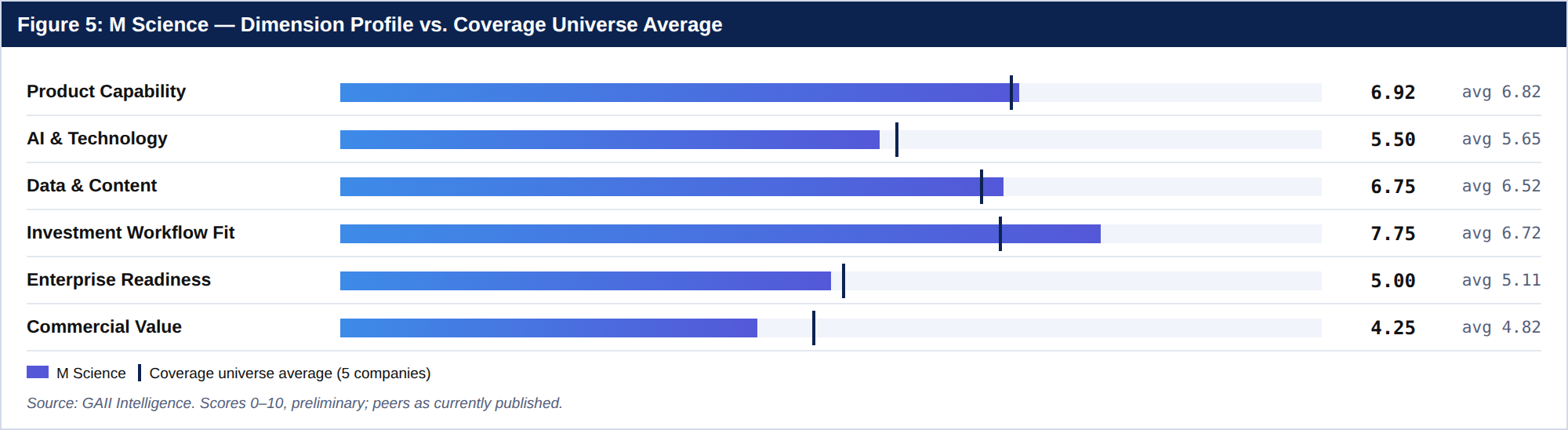
| DIMENSION | WEIGHT | SCORE | ASSESSMENT |
| 1. Product Capability | 20% | 6.92 | Broad product with analyst research. |
| 2. AI & Technology | 20% | 5.50 | Recent AI launches; little disclosure. |
| 3. Data & Content | 17.5% | 6.75 | Strong point-in-time history. |
| 4. Investment Workflow Fit | 17.5% | 7.75 | Highest Workflow Fit in segment. |
| 5. Enterprise Readiness | 15% | 5.00 | Owner strong; evidence not located. |
| 6. Commercial Value | 10% | 4.25 | No pricing. |
| GAII OVERALL SCORE | 100% | 6.20 | Emerging; Emerging quadrant. |
Open Questions
These are the areas where our public review did not find sufficient evidence to form a settled view. We have put them to the company and will update this note when they are answered. Prospective clients may find them a useful agenda for their own evaluation call.
- SOC 2 or ISO 27001 status.
- SSO/SAML and audit logging.
- Model providers behind Maddie and the MCP server.
- No-training and data-retention terms.
- Source consent, MNPI and PII screening.
- Panel sizes and representativeness.
- Current coverage count.
- Back-test or predictive-value results.
- Pricing and trial terms.
- Quantified client references.
- Jefferies information-barrier arrangements.
- Excel delivery.
Context — How To Use This Research
This note is an assessment of a vendor against a defined framework, not a recommendation to buy or to decline. The following are the considerations we would put at the centre of an evaluation of M Science specifically.
If you run research or data sourcing
- Test UDM history point-in-time against reported KPIs.
- Pilot the MCP server with analysts.
- Use Maddie alerts for KPI monitoring.
If you are responsible for technology, compliance or vendor risk
- Open with Figure 3; request attestations and AI terms.
- Confirm Jefferies information barriers.
- Review data-share entitlements.
If you are assessing the category rather than the company
- Curated data is being rebuilt for AI agents.
- Data shares and MCP now sit side by side.
- Point-in-time integrity is becoming a selling point.
Appendix A — Sub-criteria Detail
Each dimension score in Section 12 is the mean of the sub-criteria below. Data & Content and Investment Workflow Fit use the Alternative Data & Data Infrastructure segment variant.
| DIMENSION | SUB-CRITERION | SCORE |
| Product Capability | Workflow breadth | 8.0 |
| Output quality | 7.0 | |
| Agentic autonomy and task horizon | 6.0 | |
| Usability and time-to-value | 6.5 | |
| Deliverable fidelity (reports, dashboards, analyst notes) | 8.0 | |
| Configurability to firm framework | 6.0 | |
| AI & Technology | Model strategy and provider dependency | 5.0 |
| AI in collection, cleaning and entity mapping | 5.0 | |
| Answer grounding and methodology transparency | 6.5 | |
| Published evaluation evidence (incl. predictive-value studies) | 2.5 | |
| Engineering depth | 6.5 | |
| Shipping velocity | 7.5 | |
| Data & Content | Panel or source breadth and representativeness | 7.0 |
| History depth and point-in-time integrity | 8.0 | |
| Coverage of the investable universe (ticker mapping, entity resolution) | 7.0 | |
| Timeliness and delivery latency | 7.0 | |
| Data provenance, licensing and compliance (consent, MNPI and PII screening) | 5.0 | |
| Documentation and auditability (methodology, change logs) | 6.5 | |
| Investment Workflow Fit | Buy-side native design | 8.5 |
| Signal research and backtest support (predictive-value evidence) | 6.5 | |
| Monitoring and alerting | 7.0 | |
| Quant and modelling delivery (Snowflake, Databricks, S3, API, Python) | 9.0 | |
| Desktop and AI-assistant delivery (Excel, MCP, connectors) | 7.5 | |
| Client service and analyst support | 8.0 | |
| Enterprise Readiness | Security certification evidence | 3.0 |
| Deployment options | 6.5 | |
| Data governance and no-training commitments | 3.0 | |
| Access control and audit logging | 3.0 | |
| Regulatory compliance and MNPI controls | 5.0 | |
| Vendor viability and scale | 7.5 | |
| Support and service model | 7.0 | |
| Commercial Value | Price transparency | 2.0 |
| Total cost of ownership | 5.0 | |
| Value against the alternative | 7.0 | |
| Contract flexibility and trial | 3.5 | |
| Documented return-on-investment evidence | 3.0 | |
| Pricing-model alignment | 5.0 |
Methodology
The GAII Intelligence Framework scores every company in coverage on six dimensions, each built from sub-criteria. Evidence is weighted in descending order: verifiable primary evidence such as attestations, contracts, published documentation and named references; then the company's completed GAII questionnaire and analyst briefing; then public secondary sources. Claims that cannot be corroborated are recorded as company-reported and do not raise a score.
| 1. Product Capability | 20% | What the product does: workflow breadth, output quality, agentic autonomy, usability, fidelity of deliverables, configurability. |
| 2. AI & Technology | 20% | How it is built: model strategy and provider dependency, retrieval and reasoning, citation fidelity, published evaluation, engineering depth, shipping velocity. |
| 3. Data & Content | 17.5% | What it knows: filings and transcripts, expert content, broker research, consensus data, client-material ingestion, coverage and auditability. |
| 4. Investment Workflow Fit | 17.5% | How it fits the process: buy-side design, idea generation, monitoring, modelling, delivery surfaces, adoption support. |
| 5. Enterprise Readiness | 15% | Whether it can be bought: certifications, deployment, data governance, access control, compliance, vendor viability, support. |
| 6. Commercial Value | 10% | Whether it is worth it: price transparency, total cost of ownership, value against the alternative, contract flexibility, return evidence, pricing alignment. |
Rating bands
| 8.5 – 10.0 | Leader | Category-defining capability with the platform maturity to support standardisation across a firm. |
| 7.5 – 8.4 | Strong | Suitable for enterprise deployment following normal diligence. |
| 6.5 – 7.4 | Established | Credible for targeted deployment, with specific areas to clarify during evaluation. |
| 5.5 – 6.4 | Emerging | Well suited to pilot deployment while particular capabilities continue to develop. |
| Below 5.5 | Specialist | Deliberately narrow functional focus, or areas we are still evaluating. |
Outlook definitions: Improving — we expect the overall score to rise at the next review on evidence already visible. Stable — no directional change expected within two review cycles. Softening — we expect the score to decline on competitive, commercial or execution evidence. Under Evaluation — material questions remain open; the score may move in either direction once they are resolved.
Matrix construction: Investment Utility (horizontal) = Product Capability × 0.40 + Data & Content × 0.30 + Investment Workflow Fit × 0.30. Market & Innovation Strength (vertical) = AI & Technology × 0.40 + Enterprise Readiness × 0.35 + Momentum × 0.25, where Momentum is a separate 0–10 assessment of capital position, traction, growth and strategic backing. Quadrant boundaries sit at 7.50 on both axes for the current cohort and are restated at each quarterly review.
Relationship Disclosure
GAII Institute organises the annual Generative AI in Investment Management (GAIIM) conference, at which companies covered in this universe may appear as speakers, exhibitors or sponsors. No relationship between GAII Institute and M Science or Jefferies was identified at the date of this note. Scored on the GAII segment variant for Alternative Data & Data Infrastructure: Data & Content and Investment Workflow Fit use alternative-data sub-criteria (panel breadth, point-in-time integrity, ticker mapping, timeliness, provenance and compliance, documentation; signal research support, monitoring, quant delivery, desktop and AI-assistant delivery, analyst support). Weights and the other four dimensions are unchanged. Scores are comparable within the segment, not directly with Research & Intelligence or Risk, Compliance & Surveillance scores.
Important Disclosures
Copyright and distribution. © 2026 GAII Institute. All rights reserved. GAII Intelligence and GAII Intelligence Matrix are marks of GAII Institute. This publication is licensed to the named recipient and may not be reproduced, redistributed, republished, posted, transmitted or made available to any other person, in whole or in part, in any form or by any means, without the prior written permission of GAII Institute.
Nature of this publication. This publication consists of the opinions of the GAII Intelligence research team as at the date shown and is subject to change without notice. It should not be construed as a statement of fact. While the information contained in it has been obtained from sources believed to be reliable, GAII Institute disclaims all warranties, express or implied, as to the accuracy, completeness or adequacy of that information. Ratings and scores are analytical opinions and are not a guarantee of any vendor's performance, viability or suitability.
Not investment, legal or procurement advice. Although GAII Intelligence research may address commercial, legal and financial matters, GAII Institute does not provide investment, legal or accounting advice, and this publication should not be construed or used as such. It is not a recommendation to buy, sell or hold any security or private interest, and it is not a substitute for the reader's own evaluation, diligence and procurement process.
Independence and objectivity. GAII Intelligence ratings are not for sale. No fee, sponsorship, membership, conference participation or other commercial relationship influences a rating, a score or a position on the GAII Intelligence Matrix, and analysts are not compensated on the basis of vendor relationships. Covered companies receive a factual-accuracy review before publication; they may correct factual errors and may not alter analysis, scores or wording.
Use in artificial intelligence systems. This publication may not be used as input into, or for the training, fine-tuning or development of, any generative artificial intelligence model, machine learning system, algorithm, software or related technology.
Log in as a member to download the full report.