
Hadrius: Initiation of Coverage
Market Definition
GAII Intelligence defines the Risk, Compliance & Surveillance market as software that applies AI to the supervisory obligations of investment firms, banks and trading venues: capturing and retaining communications and trading records, detecting misconduct and market abuse, reviewing regulated content, and evidencing those controls to regulators. Buyers are chief compliance officers, heads of surveillance and conduct risk, and the technology and records teams that support them.
Capabilities we treat as mandatory
- Complete, defensible capture: records of every in-scope channel or trading system, reconciled and retained to regulatory standards such as SEC 17a-4.
- Explainable detection: every alert or finding traceable to the policy, rule or signal that produced it, in a form a regulator can examine.
- Institutional data handling: a stated position on where client data goes, how long it is held, and whether it is used for model training.
Capabilities we treat as differentiating
- False-positive reduction: measurable cuts in alert volume without loss of true positives, with a disclosed method.
- Agentic triage: agents that disposition first-level alerts and assemble cases under human supervision.
- Holistic coverage: communications, trade and conduct data analysed together rather than in separate tools.
- AI-channel governance: capture and supervision of employees' use of AI assistants as a regulated channel.
Hadrius competes with Smarsh, Global Relay and Theta Lake in communications archiving, with StarCompliance and ComplySci in personal trading, with ACA Group and other consultancies in outsourced compliance, and with Norm Ai in AI-led marketing and policy review.
Strengths
The following are the capabilities and characteristics that, in our assessment, most distinguish Hadrius within the Risk, Compliance & Surveillance market. Each is drawn from publicly documented product capability, published interviews with management, or independent review.
- Breadth for smaller firms: Communications, marketing, trading, branches and testing in one platform aimed at lean compliance teams.
- Shipping velocity: Six launches between January 2025 and September 2026, including AI Governance and a Claude archive.
- AI-channel governance: Capture and supervision of employee use of Claude and ChatGPT, chosen by Ritholtz Wealth Management for a firmwide rollout.
- Data handling: Zero-retention inference with OpenAI; client data not used to train shared models (company).
- Custodian integration: Nightly feeds from Schwab, Fidelity, Pershing, NFS, Raymond James and Altruist, plus BridgeFT.
- Distribution: Partnerships with compliance consultants and named clients including BBVA, Altruist, Allworth Financial and M1 Finance.
Cautions
The following are factors that prospective clients should weigh, and areas where our public review did not find sufficient evidence to reach a settled view. Several are common across vendors at this stage of the market and are not specific to Hadrius. We encourage prospective clients to raise each of them directly with the company; we have done the same, and will update this note as answers arrive.
- Assurance: SOC 2 Type II is stated by the vendor but the report was not located; ISO 27001, SSO and audit logging were not documented.
- Evidence: False-positive and time-saving figures are company-reported, with no published methodology or evaluation.
- Model dependency: Generative features rely on OpenAI; alternative providers are not disclosed.
- Scale: Founded in 2023 with $27m raised; headcount is not disclosed.
- Scope: US SEC and FINRA rules only; no multi-jurisdiction coverage.
- Detection transparency: The scenario library and full channel list are not public.
- Pricing: No public pricing and no trial located.
Company Profile
Hadrius, Inc. was founded in New York in 2023 by Thomas Stewart (CEO), Allen Calderwood (CTO) and Som Mohapatra (COO), who had previously built Quantbase, a quantitative investing platform sold to Surmount AI in March 2025. It was part of Y Combinator and in 2026 hired Benjamin Huber, formerly head of product at ACA Group, and go-to-market leaders from StarCompliance, Orion and Smarsh.
Hadrius raised a seed round (announced at $2m in September 2023; $5m in total) and a $22m Series A led by CRV in July 2026, with Y Combinator, Pathlight Ventures and founders of Altruist, Jump and FINNY — $27m in all. Valuation, revenue and headcount are not disclosed.

| Legal entity | Hadrius, Inc. |
| Founded | 2023 |
| Founders | Thomas Stewart; Allen Calderwood; Som Mohapatra |
| Headquarters | New York, NY |
| Headcount | Not disclosed |
| Disclosed funding | $27m: seed $5m; Series A $22m (CRV, July 2026) |
| Valuation | Not disclosed |
| Revenue | Not disclosed |
| Clients | 500+ firms (company) |
| Named clients | BBVA, Altruist, Allworth, M1 Finance, Ritholtz Wealth Management |
| AI layer | Context IQ and agentic workflows (April 2026) |
| Assurance | SOC 2 Type II (vendor-stated) |
Company-reported figures are shown as such and are not independently verified. Verification is carried into the vendor questionnaire.
Product and Capabilities
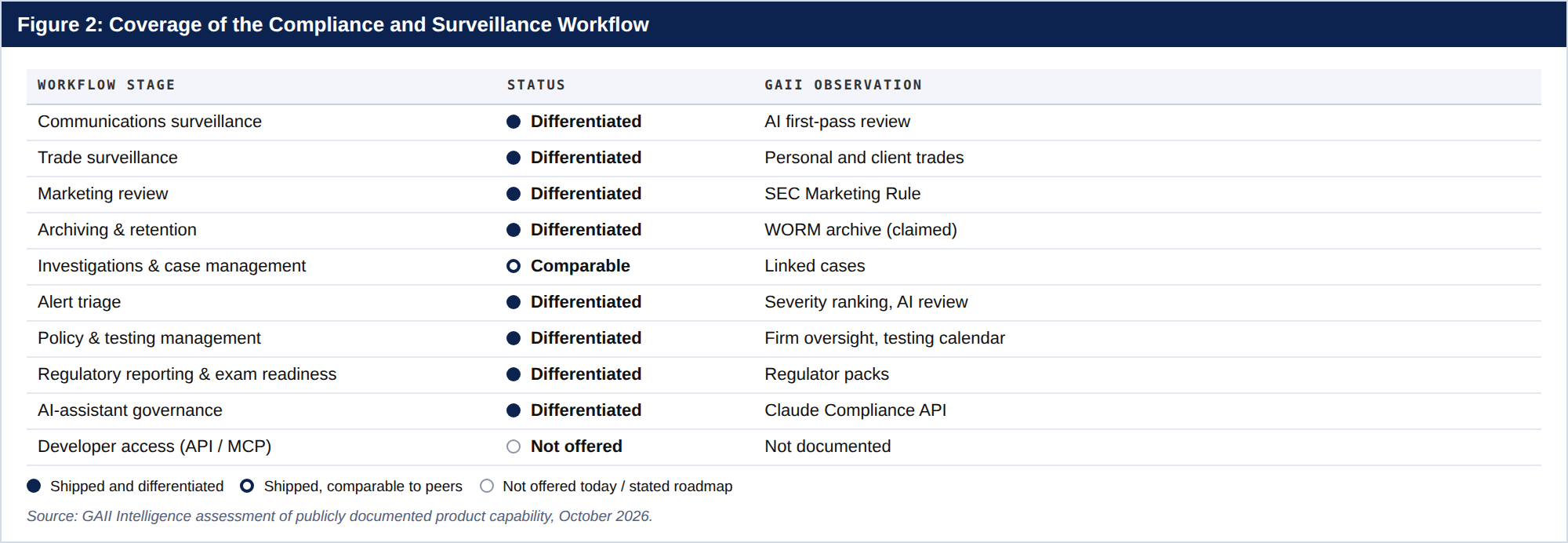
Hadrius organises its platform around six modules for SEC- and FINRA-regulated firms. Figure 2 sets out our assessment of how it maps onto the compliance and surveillance workflow.
Communications and AI Governance
Multi-channel capture, WORM archive and AI surveillance, including Claude and ChatGPT activity.
Marketing review
AI review of marketing materials against the SEC Marketing Rule and FINRA rules.
Trade surveillance
Personal and client trade monitoring, pre-clearance and prediction-market activity.
Firm oversight and branches
Testing calendars, policies, risk assessments and branch inspections.
Scope of the product today
We did not locate a public API, a published scenario library or multi-jurisdiction coverage.
AI and Technology
Hadrius uses AI for the first review of communications, marketing and trades rather than as a filter on rule alerts. Context IQ connects each item to the employee, supervision structure, history and firm policy; agentic workflows run testing and prioritise risk for human review.
Generative features use OpenAI through stateless, zero-retention inference. Accuracy figures are company-reported and no evaluation is published.
Data and Content
Hadrius captures email, messaging and enterprise AI chat — more than 30 channels by its count — into a WORM archive, and ingests trades nightly from major US custodians, OMS platforms and BridgeFT.
Detection combines AI review against SEC and FINRA rules with a no-code rule builder; the scenario library is not published.
Investment Workflow Fit
Hadrius fits the chief compliance officer of a small or mid-sized adviser or broker: one system of record for surveillance, marketing review, testing and exam readiness.
Larger institutions will find integration documentation and assurance thinner than at established vendors.
Enterprise Readiness
Hadrius states SOC 2 Type II compliance on its security page and uses zero-retention inference. Figure 3 sets out what our public review located.
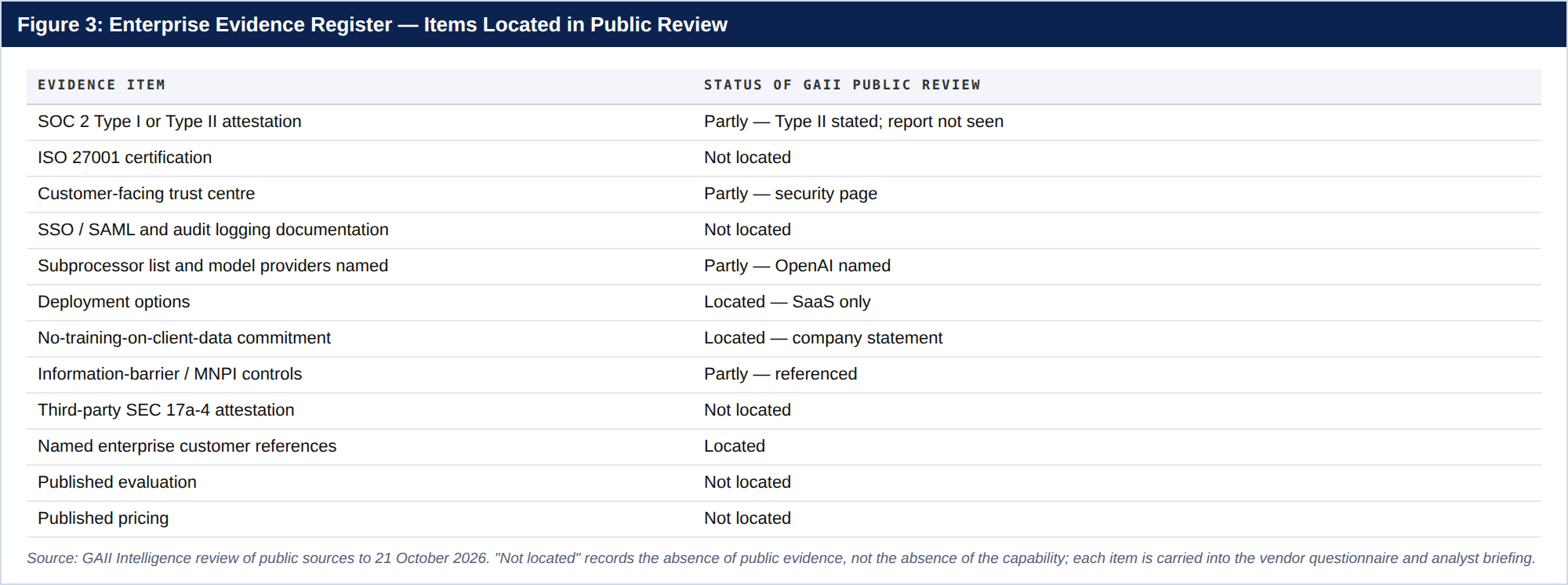
We would encourage buyers to request the SOC 2 report, ISO 27001 status, SSO and audit-logging documentation and model-provider terms.
The offsetting factor is data handling: a stated zero-retention, no-training design.
Commercial Model
Hadrius does not publish pricing. It claims average savings above $35,000 a year per compliance team and positions itself against consultancies and point solutions.
Buyers should seek quantified references and module-level pricing.
Competitive Position
Hadrius sits in the Emerging quadrant of the segment matrix, with investment utility (X 6.72) ahead of AI and enterprise evidence (Y 6.32).
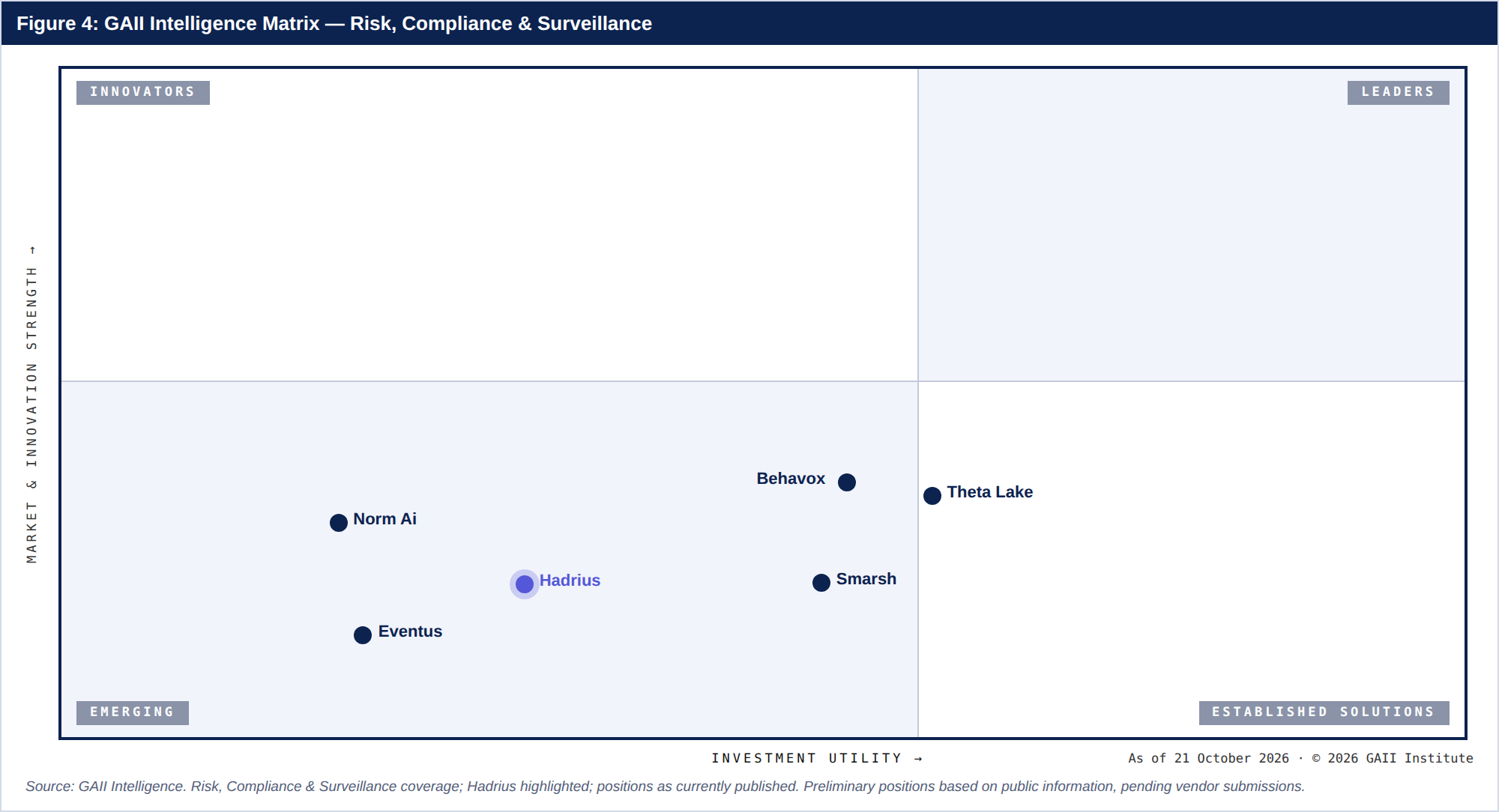
| COMPANY | SCORE | RATING | OUTLOOK | MATRIX QUADRANT |
| Theta Lake | 6.87 | Established | Improving | Established Solutions |
| Behavox | 6.83 | Established | Improving | Emerging |
| Smarsh | 6.65 | Established | Stable | Emerging |
| Hadrius | 6.09 | Emerging | Improving | Emerging |
| Eventus | 6.00 | Emerging | Stable | Emerging |
| Norm Ai | 5.99 | Emerging | Improving | Emerging |
GAII Risk, Compliance & Surveillance coverage, 20 October 2026, scored on the segment variant of Data & Content and Workflow Fit; not directly comparable with Research & Intelligence scores.
11.1 Where Hadrius is strongest relative to peers
- Against archive incumbents, on AI-first review and AI-channel governance.
- Against consultancies, on cost and automation.
- Against point solutions, on breadth for small firms.
11.2 Areas of narrower functional focus
Hadrius has built breadth and release pace ahead of assurance and evidence.
- Assurance: ISO 27001 and SSO not located.
- Evidence: company-reported metrics.
- Scope: US rules only.
- Scale: early-stage company.
Score Summary
Scores are on a 0–10 scale. Each dimension score is the mean of its sub-criteria, and the GAII Overall Score is the weighted mean of the six dimensions. The detailed sub-criteria scores that build each dimension are set out in Appendix A.
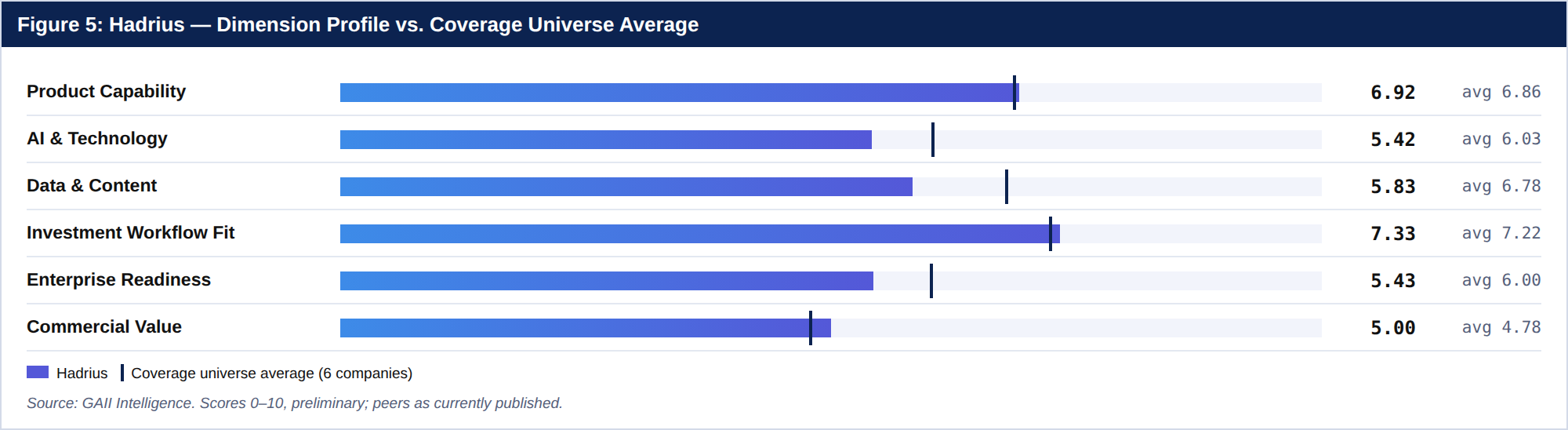
| DIMENSION | WEIGHT | SCORE | ASSESSMENT |
| 1. Product Capability | 20% | 6.92 | Broad for small firms. |
| 2. AI & Technology | 20% | 5.42 | Fast shipping; little evaluation. |
| 3. Data & Content | 17.5% | 5.83 | Good custodian data; library unpublished. |
| 4. Investment Workflow Fit | 17.5% | 7.33 | Compliance-native; exam-ready. |
| 5. Enterprise Readiness | 15% | 5.43 | SOC 2 stated; documentation gaps. |
| 6. Commercial Value | 10% | 5.00 | No pricing. |
| GAII OVERALL SCORE | 100% | 6.09 | Emerging; Emerging quadrant. |
Open Questions
These are the areas where our public review did not find sufficient evidence to form a settled view. We have put them to the company and will update this note when they are answered. Prospective clients may find them a useful agenda for their own evaluation call.
- SOC 2 Type II report period and auditor.
- ISO 27001 status.
- SSO/SAML, SCIM and audit logging.
- Model providers beyond OpenAI and contractual no-training terms.
- Full channel list and third-party 17a-4 attestation.
- False-positive methodology.
- Scenario library contents.
- Headcount and support capacity.
- Revenue and growth.
- Public API plans.
- Pricing.
- Quantified client references.
Context — How To Use This Research
This note is an assessment of a vendor against a defined framework, not a recommendation to buy or to decline. The following are the considerations we would put at the centre of an evaluation of Hadrius specifically.
If you run compliance or surveillance
- Pilot AI review on marketing and communications.
- Test AI Governance if rolling out Claude or ChatGPT.
- Check scenario coverage against your exam findings.
If you are responsible for technology or vendor risk
- Open with Figure 3; request the SOC 2 report and SSO detail.
- Review OpenAI terms and data flow.
- Confirm custodian feed coverage.
If you are assessing the category rather than the company
- AI assistants are becoming a regulated communications channel.
- AI-first review is reaching smaller advisers.
- Software is competing with outsourced compliance consultancies.
Appendix A — Sub-criteria Detail
Each dimension score in Section 12 is the mean of the sub-criteria below. Data & Content and Investment Workflow Fit use the Risk, Compliance & Surveillance segment variant.
| DIMENSION | SUB-CRITERION | SCORE |
| Product Capability | Workflow breadth | 8.0 |
| Output quality | 6.5 | |
| Agentic autonomy and task horizon | 6.0 | |
| Usability and time-to-value | 7.5 | |
| Deliverable fidelity (case files, reports, regulatory outputs) | 6.5 | |
| Configurability to firm policy | 7.0 | |
| AI & Technology | Model strategy and provider dependency | 5.5 |
| Retrieval and reasoning architecture | 6.0 | |
| Explainability and false-positive control | 5.0 | |
| Published evaluation evidence | 2.0 | |
| Engineering depth | 5.5 | |
| Shipping velocity | 8.5 | |
| Data & Content | Communications-channel coverage | 6.0 |
| Capture fidelity and data lineage | 5.0 | |
| Retention and archive integrity | 6.0 | |
| Detection model and scenario library | 5.5 | |
| Client-proprietary ingestion | 7.0 | |
| Coverage breadth and source auditability | 5.5 | |
| Investment Workflow Fit | Compliance-native design | 8.5 |
| Alert triage and investigation | 7.0 | |
| Policy and rule management | 7.5 | |
| Regulatory reporting and exam readiness | 7.5 | |
| Integrations (OMS/EMS, communications, HR, case management) | 6.5 | |
| Adoption support and change management | 7.0 | |
| Enterprise Readiness | Security certification evidence | 6.0 |
| Deployment options | 4.0 | |
| Data governance and no-training commitments | 6.5 | |
| Access control and audit logging | 4.0 | |
| Regulatory compliance and MNPI controls | 5.5 | |
| Vendor viability and scale | 6.0 | |
| Support and service model | 6.0 | |
| Commercial Value | Price transparency | 2.5 |
| Total cost of ownership | 6.0 | |
| Value against the alternative | 7.0 | |
| Contract flexibility and trial | 4.0 | |
| Documented return-on-investment evidence | 5.0 | |
| Pricing-model alignment | 5.5 |
Methodology
The GAII Intelligence Framework scores every company in coverage on six dimensions, each built from sub-criteria. Evidence is weighted in descending order: verifiable primary evidence such as attestations, contracts, published documentation and named references; then the company's completed GAII questionnaire and analyst briefing; then public secondary sources. Claims that cannot be corroborated are recorded as company-reported and do not raise a score.
| 1. Product Capability | 20% | What the product does: workflow breadth, output quality, agentic autonomy, usability, fidelity of deliverables, configurability. |
| 2. AI & Technology | 20% | How it is built: model strategy and provider dependency, retrieval and reasoning, citation fidelity, published evaluation, engineering depth, shipping velocity. |
| 3. Data & Content | 17.5% | What it knows: filings and transcripts, expert content, broker research, consensus data, client-material ingestion, coverage and auditability. |
| 4. Investment Workflow Fit | 17.5% | How it fits the process: buy-side design, idea generation, monitoring, modelling, delivery surfaces, adoption support. |
| 5. Enterprise Readiness | 15% | Whether it can be bought: certifications, deployment, data governance, access control, compliance, vendor viability, support. |
| 6. Commercial Value | 10% | Whether it is worth it: price transparency, total cost of ownership, value against the alternative, contract flexibility, return evidence, pricing alignment. |
Rating bands
| 8.5 – 10.0 | Leader | Category-defining capability with the platform maturity to support standardisation across a firm. |
| 7.5 – 8.4 | Strong | Suitable for enterprise deployment following normal diligence. |
| 6.5 – 7.4 | Established | Credible for targeted deployment, with specific areas to clarify during evaluation. |
| 5.5 – 6.4 | Emerging | Well suited to pilot deployment while particular capabilities continue to develop. |
| Below 5.5 | Specialist | Deliberately narrow functional focus, or areas we are still evaluating. |
Outlook definitions: Improving — we expect the overall score to rise at the next review on evidence already visible. Stable — no directional change expected within two review cycles. Softening — we expect the score to decline on competitive, commercial or execution evidence. Under Evaluation — material questions remain open; the score may move in either direction once they are resolved.
Matrix construction: Investment Utility (horizontal) = Product Capability × 0.40 + Data & Content × 0.30 + Investment Workflow Fit × 0.30. Market & Innovation Strength (vertical) = AI & Technology × 0.40 + Enterprise Readiness × 0.35 + Momentum × 0.25, where Momentum is a separate 0–10 assessment of capital position, traction, growth and strategic backing. Quadrant boundaries sit at 7.50 on both axes for the current cohort and are restated at each quarterly review.
Relationship Disclosure
GAII Institute organises the annual Generative AI in Investment Management (GAIIM) conference, at which companies covered in this universe may appear as speakers, exhibitors or sponsors. No relationship between GAII Institute and Hadrius, Inc. was identified at the date of this note. Scored on the GAII segment variant for Risk, Compliance & Surveillance: Data & Content and Investment Workflow Fit use compliance-specific sub-criteria (channel coverage, capture and lineage, retention, detection library; triage, policy management, exam readiness, integrations). Weights and the other four dimensions are unchanged. Scores are comparable within the segment, not directly with Research & Intelligence scores.
Important Disclosures
Copyright and distribution. © 2026 GAII Institute. All rights reserved. GAII Intelligence and GAII Intelligence Matrix are marks of GAII Institute. This publication is licensed to the named recipient and may not be reproduced, redistributed, republished, posted, transmitted or made available to any other person, in whole or in part, in any form or by any means, without the prior written permission of GAII Institute.
Nature of this publication. This publication consists of the opinions of the GAII Intelligence research team as at the date shown and is subject to change without notice. It should not be construed as a statement of fact. While the information contained in it has been obtained from sources believed to be reliable, GAII Institute disclaims all warranties, express or implied, as to the accuracy, completeness or adequacy of that information. Ratings and scores are analytical opinions and are not a guarantee of any vendor's performance, viability or suitability.
Not investment, legal or procurement advice. Although GAII Intelligence research may address commercial, legal and financial matters, GAII Institute does not provide investment, legal or accounting advice, and this publication should not be construed or used as such. It is not a recommendation to buy, sell or hold any security or private interest, and it is not a substitute for the reader's own evaluation, diligence and procurement process.
Independence and objectivity. GAII Intelligence ratings are not for sale. No fee, sponsorship, membership, conference participation or other commercial relationship influences a rating, a score or a position on the GAII Intelligence Matrix, and analysts are not compensated on the basis of vendor relationships. Covered companies receive a factual-accuracy review before publication; they may correct factual errors and may not alter analysis, scores or wording.
Use in artificial intelligence systems. This publication may not be used as input into, or for the training, fine-tuning or development of, any generative artificial intelligence model, machine learning system, algorithm, software or related technology.
Log in as a member to download the full report.