
Samaya AI: Coverage Update — 21 Oct 2026
Coverage history
2 notes · ratings as published in each note| Date | Note | Rating · Score | Outlook | |
|---|---|---|---|---|
| 21 Oct 2026 | Coverage Update This note GAII-IC-2026-033 | Established · 6.82 | Improving | Log in |
| 20 Oct 2026 | Initiation of Coverage GAII-IC-2026-003 | Strong · 7.5 | Improving | Log in |
Market Definition
GAII Intelligence defines the AI Research & Intelligence market as software that applies generative and agentic AI to the research process of professional investors: locating candidate securities, assembling and interrogating evidence, producing written analysis with traceable sources, and monitoring positions once held. Buyers are hedge funds, long-only managers, multi-manager platforms, family offices and allocators; the economic buyer is typically the chief technology officer, the head of research, or a portfolio manager with a technology budget.
Capabilities we treat as mandatory
- Evidence retrieval at scale: the ability to search and reason across regulatory filings, transcripts and news, and across documents the client supplies.
- Source traceability: every material claim in an output must be reachable back to the passage that supports it.
- Institutional data handling: a stated position on where client data goes, how long it is held, and whether it is used for model training.
Capabilities we treat as differentiating
- Persistent state: the system remembers a thesis, a coverage list or a position between sessions and acts on it without being re-prompted.
- Workflow surfaces: delivery inside the applications analysts already use — the spreadsheet, the research management system, email and messaging.
- Owned or exclusive content: material that a competitor cannot obtain by signing the same third-party contract.
- Published evaluation: a measured, disclosed accuracy methodology rather than an assertion of quality.
Samaya competes across both the sell-side and buy-side segments of this market, which makes it unusual in our coverage universe. Its closest functional comparisons are Hebbia, which runs agentic research over large document sets for banks and asset managers, and Rogo, which also built its franchise inside investment banks. It does not compete directly with Daloopa, which supplies structured financial data and is itself a Samaya content partner, or with Endex, whose centre of gravity is the spreadsheet.
Strengths
The following are the capabilities and characteristics that, in our assessment, most distinguish Samaya within the AI Research & Intelligence market. Each is drawn from publicly documented product capability, published interviews with management, or independent hands-on review.
- Research pedigree: The founding team came from Google Brain, the Stanford NLP group, Meta FAIR and AWS AI, and has published on retrieval and long-context reasoning in venues including TACL, EMNLP and Nature Machine Intelligence. The company lists thirteen papers. In our assessment this is the deepest applied-research bench in the cohort, and it is visible where it matters most for this category: retrieval quality and citation fidelity.
- Broker research and entitled content: Samaya connects to a firm's approved brokers through BlueMatrix, to LSEG broker research and to Morgan Stanley Research, alongside Third Bridge, Visible Alpha, FactSet, S&P Capital IQ, PitchBook and Daloopa. Broker research is the weakest content area for most peers we cover. Provider entitlements are enforced across the platform, the API and MCP, which is the right design for licensed content.
- Tier-1 bank deployment: Morgan Stanley's Global Director of Research described a partnership "across all divisions of our Institutional Securities Group", covering research, sales and trading, and banking. The company reports more than 10,000 professionals using the platform at one of the world's largest banks. Deployment at that scale implies completion of a global systemically important bank's vendor risk process.
- Agentic depth: Agents run one-off, on a schedule, or on triggers such as an earnings release, an FOMC decision or a new quarterly filing, and deliver finished reports to an inbox. The Agent Control Plane adds a planner, long-horizon execution, memory and context management. This is among the most complete agent frameworks we have reviewed in the category.
- Published evaluation: FrontierFinance, posted to arXiv in August 2026, comprises 220 analyst queries scored against 11,543 rubric items, with a public leaderboard that reports cost per query alongside accuracy. The benchmark is Samaya's own and Samaya ranks first on it, but disclosing the method is rarer in this category than it should be.
- Distribution through assistants: A Query API and an MCP service bring Samaya's sources and five finance skills (earnings recap, model build, model update, variance table and fact checker) into Claude and ChatGPT. For firms that have standardised on an enterprise assistant, this meets analysts where they already work.
- Capital and strategic backing: A $43.5m Series A led by NEA in 2025 was followed in February 2026 by strategic investment from NVentures and Databricks Ventures. Individual investors include Eric Schmidt, Yann LeCun, Jeff Dean, Reid Hoffman and David Siegel.
Cautions
The following are factors that prospective clients should weigh, and areas where our public review did not find sufficient evidence to reach a settled view. Several are common across vendors at this stage of the market and are not specific to Samaya. We encourage prospective clients to raise each of them directly with the company; we have done the same, and will update this note as answers arrive.
- Security and deployment documentation: SOC 2 documentation is available on request through a Vanta-hosted trust centre, but the report type is not stated publicly and we did not locate an ISO 27001 certification. Production data and backups are hosted in Google Cloud US regions only, and we did not locate private-cloud, single-tenant or on-premises options. Firms with data-residency requirements outside the United States should establish the position early.
- Data governance: We did not locate a public commitment that client data is not used for model training; the company refers this to its contractual terms. Model providers and subprocessors are not published. Prospective clients should request the clause, the provider list and any zero-data-retention terms.
- Client concentration: Morgan Stanley is the only client named publicly, and its endorsement appears in Samaya's own announcement rather than in a Morgan Stanley release. Morgan Stanley also operates an internally built research assistant. Buy-side adoption is evidenced only by anonymous testimonials; buy-side buyers should ask for two references from firms like their own.
- Desktop delivery: We did not locate native Excel, PowerPoint, Teams or Slack integrations. Model and document output runs through the client's own assistant via MCP, which works well where a firm has approved Claude or ChatGPT at enterprise level and less well where it has not.
- Total cost of ownership: Pricing is not published and every access path is priced by proposal. Most premium content is bring-your-own-licence or a paid add-on, and several sources, including Third Bridge, Capital IQ and Visible Alpha, are available on the platform but not through the API or MCP. Buyers should model the platform fee and the content licences together.
- Team scale: Company job listings put headcount at approximately 32. Two members of the founding research team now hold roles elsewhere, according to their own public profiles. This is common at this stage, but it bears on support capacity for large deployments.
- Self-reported performance: The "98% versus 53%" financial-reasoning figure cited by the company has no published methodology, and the earnings-prediction study published in October 2026 has not been peer reviewed. We would welcome independent replication of the FrontierFinance results.
Company Profile
Samaya AI, Inc. was founded in 2022 by Maithra Raghu, who spent more than six years at Google Brain after a PhD at Cornell, and was named to the TIME100 AI list and MIT Technology Review's Innovators Under 35 in 2025. The early team was drawn from the Stanford NLP group, Meta FAIR and AWS AI: AI leads Ashwin Paranjape and Yuhao Zhang both completed doctorates under Christopher Manning, and head of engineering Suharsh Sivakumar is a Google Brain alumnus. The company published research for two years before announcing its funding.
The $43.5m Series A, led by NEA with Eric Schmidt, Yann LeCun, David Siegel and Marty Chavez participating, was announced in May 2025; no valuation was disclosed. NVentures and Databricks Ventures invested in February 2026 on undisclosed terms. Company job listings indicate approximately 32 employees across Mountain View and New York. Two founding-team researchers, Jack Hessel and Fabio Petroni, now hold roles at Anthropic and EMBL respectively, according to their own profiles. Leadership beyond the technical founders is not disclosed.

| Legal entity | Samaya AI, Inc. |
| Trading name | Samaya AI |
| Founded | 2022 |
| Founders | Maithra Raghu with a founding research team from Google Brain, Stanford NLP, Meta FAIR and AWS AI |
| Chief executive | Maithra Raghu |
| Headquarters | Mountain View, CA; office in New York |
| Headcount | ~32 (company job listings, 2026) |
| Disclosed funding | $43.5m Series A (NEA, 2025); strategic investment (NVentures, Databricks Ventures, 2026), amount undisclosed |
| Valuation | Not disclosed |
| Revenue | Not disclosed |
| Clients | Morgan Stanley (named); 10,000+ professionals at one bank (company-reported) |
| Content partners | Third Bridge, PitchBook, Daloopa, Finnhub; sources include BlueMatrix, LSEG, FactSet, S&P |
Company-reported figures are shown as such and are not independently verified. Verification is carried into the vendor questionnaire.
Product and Capabilities
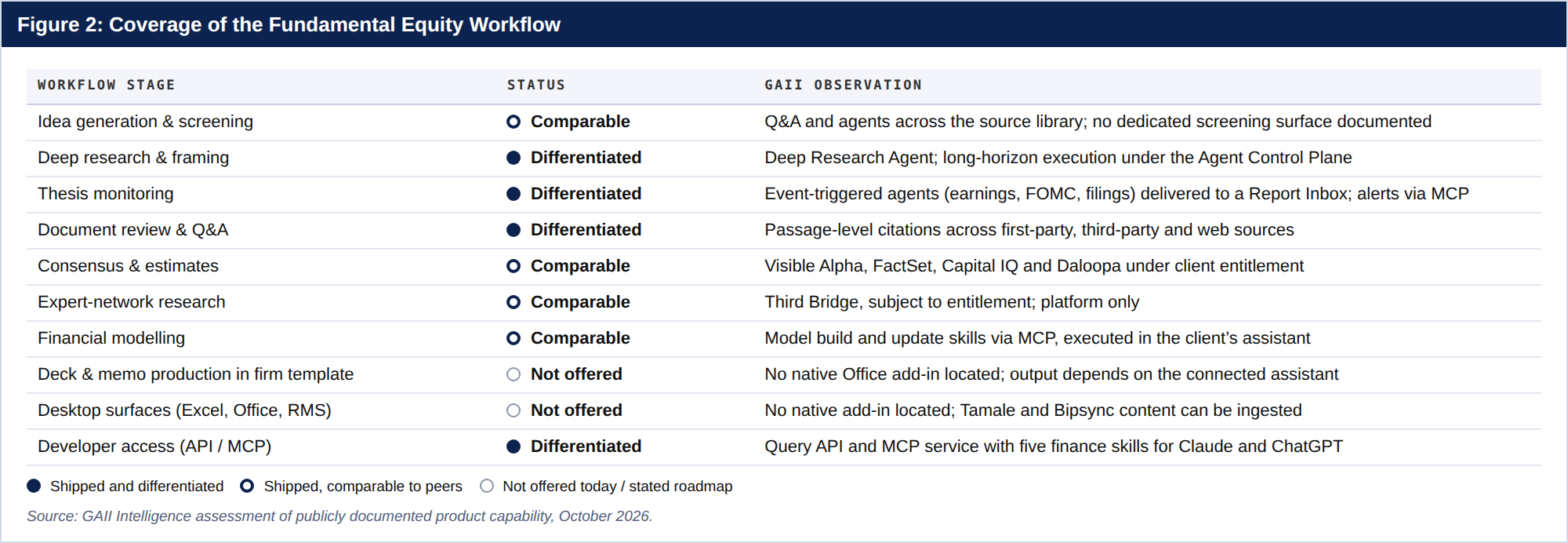
Samaya presents one research platform with three working surfaces, and two developer access paths that carry its sources into other tools. Figure 2 sets out our assessment of how the product maps onto the fundamental equity workflow.
Research and cited Q&A
Questions are answered with numbered citations to the source passage, grouped as first-party, third-party or web, and can be scoped by source and time range. Answers convert into charts, comparison tables or talking points. A library of around fifty reusable workflows, released in September 2026, packages common tasks.
Agents and the Agent Control Plane
Agents run once, on a schedule, or on an event trigger, and deliver finished reports to a Report Inbox. The Agent Control Plane, launched in February 2026, provides the planner, long-horizon executor, memory and context management underneath, configured in natural language.
Live earnings
Live transcripts with slides alongside during the call, followed by a table comparing metrics and themes with a chosen prior quarter.
API and MCP
A Query API returns cited summaries with session continuity. The MCP service brings Samaya's sources and five finance skills, together with filing and news alerts, into Claude, ChatGPT and other supported assistants.
Scope of the product today
We did not locate a native Excel, PowerPoint or Word add-in, a dedicated screening surface, or messaging integrations; modelling runs through MCP skills in the client's assistant. Causal World Models, launched with the Series A, no longer appears on the product pages, and an earnings-prediction agent is in alpha. We will confirm the status of both with the company.
AI and Technology
Samaya describes its system as a compound architecture: large language models combined with smaller purpose-built models that cross-check one another, under a planner that decomposes a task and executes it over long horizons. Answers are tied to source passages. The team's published research includes "Lost in the Middle" (TACL 2024), Promptriever, and OpaqueToolsBench (ACM CAIS 2026), and on its own benchmark the company reports a cost of $0.93 per query at standard effort.
Disclosure is the area where we would like to see more. Samaya does not name its underlying model providers; its research posts show open-weight models in experimental use, which suggests flexibility but does not establish the production stack. The company's "98% versus 53%" accuracy comparison has no published methodology, and FrontierFinance, while a genuine contribution, is self-built and ranks Samaya first.
Data and Content
The platform draws on 35 sources across nine categories: SEC, international and Basel filings and company presentations; S&P and Quartr transcripts; broker research through BlueMatrix, LSEG and Morgan Stanley Research; Third Bridge expert interviews; consensus and fundamentals from Visible Alpha, FactSet, S&P Capital IQ and Daloopa; PitchBook and Finnhub market data; MT Newswires; and central-bank material. Client documents connect through S3, Google Cloud, Google Drive, SharePoint, Outlook, SFTP and custom MCP connectors, and Tamale and Bipsync content can be scoped at set-up.
Prospective clients should note that most premium sources require the firm's own entitlement or a paid add-on, and that several are available on the platform only, not through the API or MCP. FactSet API and MCP access is described as in testing. The company cites a 99% company-coverage figure without a public definition, and geographic and language coverage is not disclosed.
Investment Workflow Fit
The product maps most strongly onto the research and monitoring stages of the process. Event-triggered agents that watch for earnings, filings and central-bank decisions, together with live earnings comparison, give an analyst a standing view of a coverage list. Access to a firm's approved broker research inside the same workflow is valuable for buy-side analysts, who consume large volumes of sell-side work.
The consideration on the other side is delivery. The platform lives in the browser and, through MCP, in the client's chosen assistant. We did not locate native spreadsheet, presentation, Teams or Slack integrations, and modelling runs through assistant-side skills. The anchor deployment is sell-side; the buy-side design is credible, but less evidenced in public.
Enterprise Readiness
This dimension carries the lowest score in our assessment, and the reason is evidentiary rather than a finding of deficiency. Figure 3 sets out what our public review located. SOC 2 documentation is available on request through a Vanta trust centre, single sign-on is supported, research access is scoped to the user and to authorised sources, and retention is set per organisation. The report type, a no-training commitment, subprocessors and deployment options were not located.
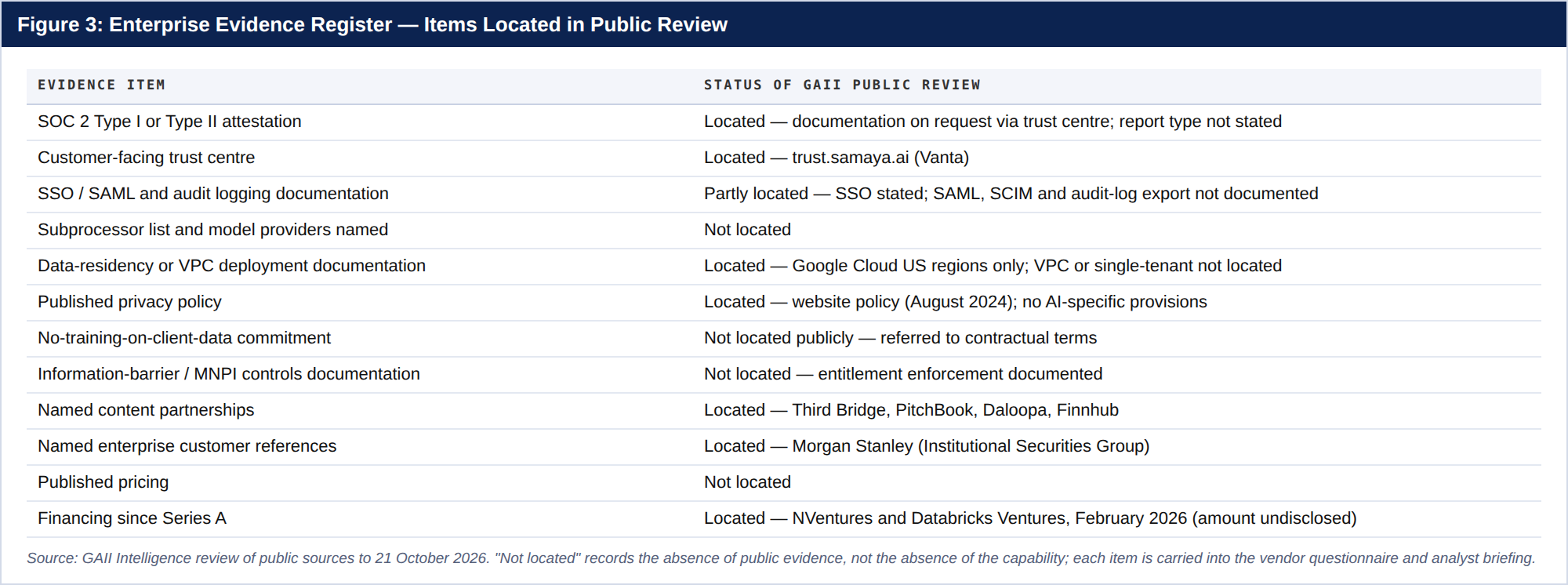
We would encourage any firm evaluating Samaya to start with the SOC 2 report type and audit period, the contractual no-training clause, and the list of model providers and subprocessors with any zero-data-retention terms. Information-barrier controls, audit-log export and SAML or SCIM provisioning should follow, along with the position on hosting outside the United States.
The offsetting factors are real. A deployment across research, sales and trading, and banking at a global systemically important bank implies a completed vendor risk review. Entitlements are enforced across all three access paths, licensed providers can impose their own restrictions, and the strategic backing from NVIDIA and Databricks reduces vendor-viability concern. Several peers at a similar stage publish comparably little.
Commercial Model
Samaya does not publish pricing. Platform, API and MCP access are each priced by proposal, scoped by users, usage, licensed data, connectors and support. Premium content is either bring-your-own-licence or a paid add-on. The FAQ refers to pilots and to starting with a single desk, but the terms are not public.
The value argument is research-hours substitution across a large professional population, and the company's cost-per-query figures suggest efficient delivery. We would encourage buyers to model total cost including content licences, and to run a pilot against their own research questions rather than a demonstration set.
Competitive Position
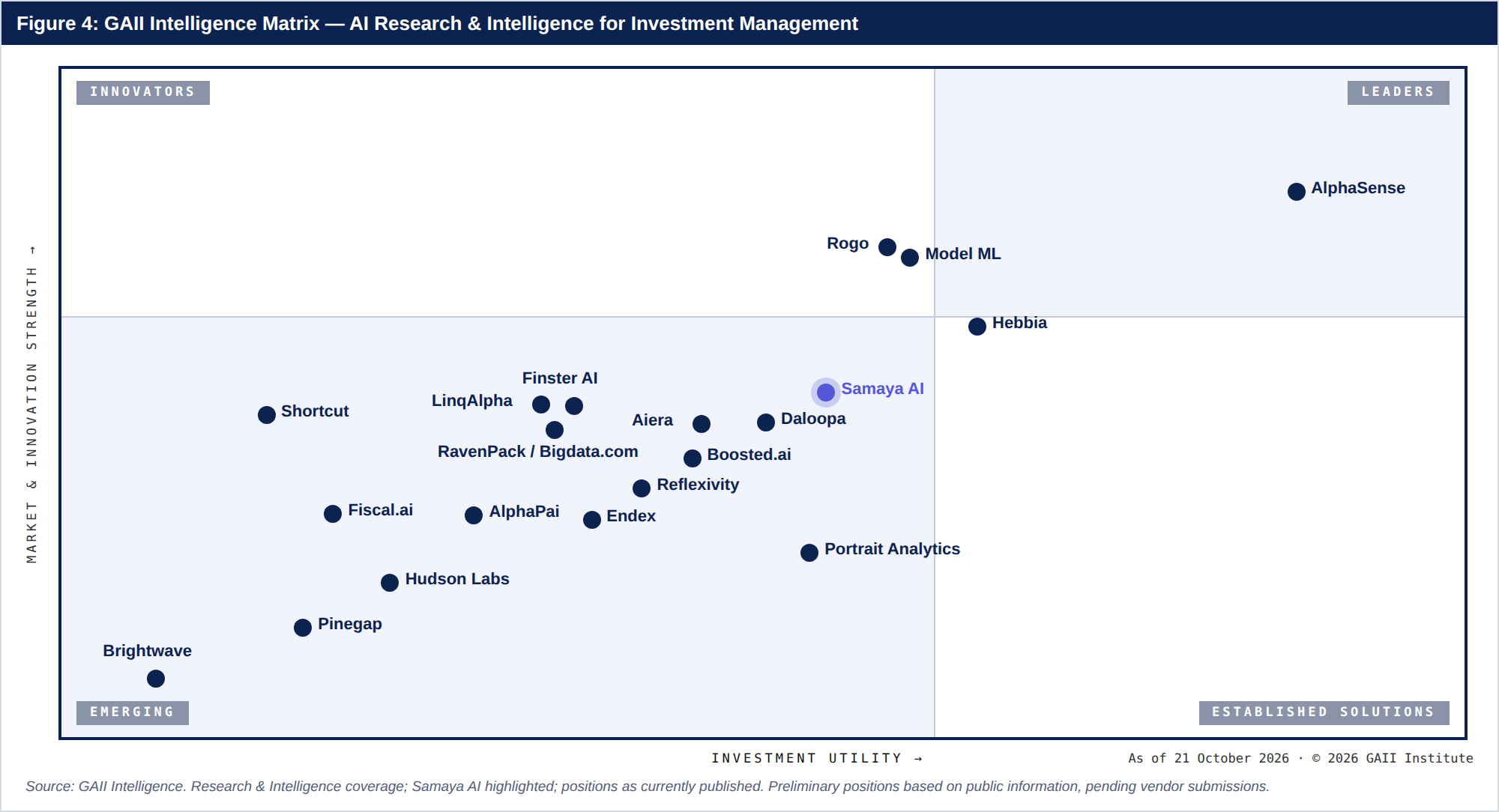
Samaya sits in the Emerging quadrant of the GAII Intelligence Matrix: Investment Utility of 7.18 rests on content breadth and research agents but is held back by desktop delivery and modelling, and Market & Innovation Strength of 6.95 by enterprise evidence despite strong momentum. Peer positions shown are as currently published; the remaining tranche-1 companies are being recalibrated to the same standard.
| COMPANY | SCORE | RATING | OUTLOOK | MATRIX QUADRANT |
| AlphaSense | 8.19 | Strong | Improving | Leaders |
| Hebbia | 7.41 | Established | Stable | Established Solutions |
| Model ML | 7.30 | Established | Improving | Innovators |
| Rogo | 7.24 | Established | Improving | Innovators |
| Samaya AI | 6.82 | Established | Improving | Emerging |
| Daloopa | 6.76 | Established | Improving | Emerging |
| Boosted.ai | 6.69 | Established | Stable | Emerging |
| Aiera | 6.62 | Established | Under Evaluation | Emerging |
| Reflexivity | 6.50 | Established | Stable | Emerging |
| RavenPack / Bigdata.com | 6.47 | Emerging | Improving | Emerging |
| Portrait Analytics | 6.38 | Emerging | Improving | Emerging |
| LinqAlpha | 6.30 | Emerging | Improving | Emerging |
| Finster AI | 6.26 | Emerging | Improving | Emerging |
| Endex | 6.02 | Emerging | Stable | Emerging |
| Hudson Labs | 6.00 | Emerging | Stable | Emerging |
| Shortcut | 5.89 | Emerging | Improving | Emerging |
| Fiscal.ai | 5.71 | Emerging | Improving | Emerging |
| AlphaPai | 5.64 | Emerging | Stable | Emerging |
| Pinegap | 5.23 | Watch | Improving | Emerging |
| Brightwave | 5.05 | Watch | Under Evaluation | Emerging |
GAII coverage universe, 21 October 2026. Peer scores as currently published on the GAII Intelligence page; the remaining tranche-1 companies are being recalibrated to the full sub-criteria standard. Preliminary and based on public information.
11.1 Where Samaya is strongest relative to peers
- Against document-analysis platforms, on licensed content: no peer in the cohort combines broker research, expert interviews and consensus data under client entitlements in one workflow.
- Against bank-focused peers, on research depth and evaluation disclosure: a published benchmark with methodology and per-query cost.
- Against content platforms, on agentic execution and developer access: scheduled and event-triggered agents, plus an MCP service into enterprise assistants.
11.2 Areas of narrower functional focus
Samaya has built depth in retrieval, agents and content access rather than in desktop presence.
- Desktop delivery: no native spreadsheet, Office or messaging integration located.
- Modelling: handled through MCP skills in the client's assistant rather than a native surface.
- Deployment: US-hosted multi-tenant SaaS; private-cloud options not documented.
- Buy-side references: public evidence concentrated in one sell-side institution.
Score Summary
Scores are on a 0–10 scale. Each dimension score is the mean of its sub-criteria, and the GAII Overall Score is the weighted mean of the six dimensions. The detailed sub-criteria scores that build each dimension are set out in Appendix A.
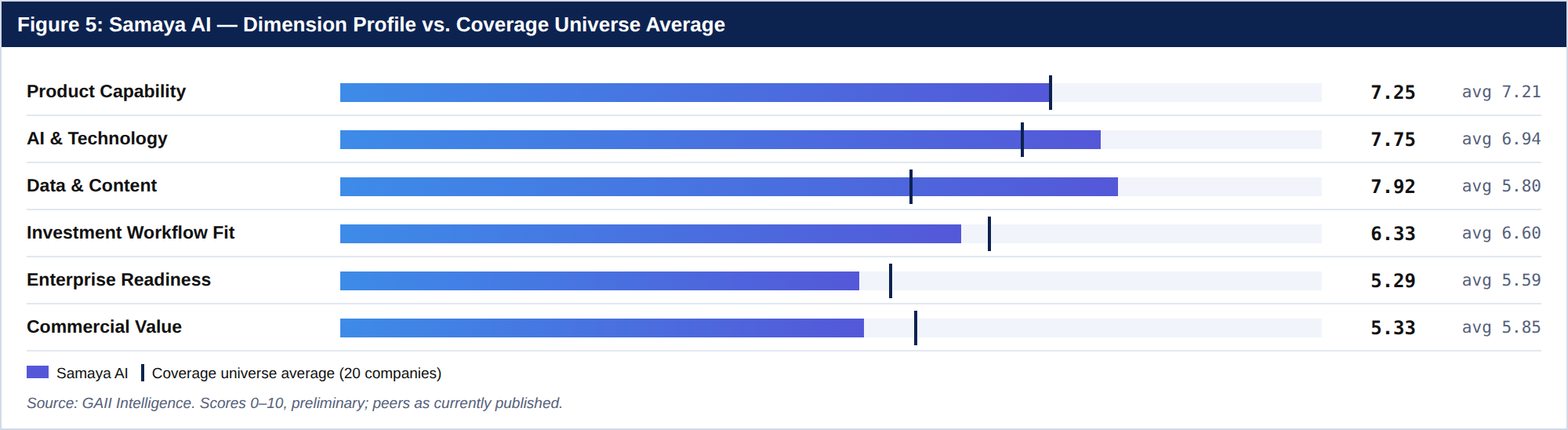
| DIMENSION | WEIGHT | SCORE | ASSESSMENT |
| 1. Product Capability | 20% | 7.25 | Broad surface set and long-horizon agents; Office deliverables depend on the client's assistant. |
| 2. AI & Technology | 20% | 7.75 | Deepest research bench in coverage; published, self-built evaluation; providers undisclosed. |
| 3. Data & Content | 17.5% | 7.92 | Broadest entitled content set, including broker research; premium sources largely bring-your-own-licence. |
| 4. Investment Workflow Fit | 17.5% | 6.33 | Strong monitoring and earnings workflow; native desktop delivery and modelling not located. |
| 5. Enterprise Readiness | 15% | 5.29 | SOC 2 documentation on request; report type, no-training terms and deployment options not public. |
| 6. Commercial Value | 10% | 5.33 | Proposal-based pricing; no quantified return-on-investment evidence published. |
| GAII OVERALL SCORE | 100% | 6.82 | Established; Emerging quadrant. |
Open Questions
These are the areas where our public review did not find sufficient evidence to form a settled view. We have put them to the company and will update this note when they are answered. Prospective clients may find them a useful agenda for their own evaluation call.
- The SOC 2 report type and audit period, and the timetable for ISO 27001 if planned.
- Whether a no-training commitment is in the standard contract, and the wording of the clause.
- The model providers in production use, and whether zero-data-retention terms are in place with each.
- The subprocessor list.
- Whether private-cloud, single-tenant or non-US hosting is available or planned.
- Information-barrier and MNPI controls, audit-log export, and SAML or SCIM provisioning.
- The scale and scope of the Morgan Stanley deployment, and whether it is the bank referred to in the 10,000-user figure.
- Named buy-side clients, and two references available under non-disclosure.
- Pricing for each access path, contract minimums and term, and pilot terms.
- Retention metrics and the typical path from pilot to firmwide deployment.
- The roadmap for native Excel, PowerPoint and Teams integration.
- The status of Causal World Models and the earnings-prediction agent.
- Current leadership beyond the founders, and the roles of founding-team members now working elsewhere.
Context — How To Use This Research
This note is an assessment of a vendor against a defined framework, not a recommendation to buy or to decline. The following are the considerations we would put at the centre of an evaluation of Samaya specifically.
If you are a fundamental equity manager
- Run a pilot against live coverage, and judge it on the quality of broker-research synthesis and event-triggered monitoring.
- Map which of your existing content licences carry over, and which Samaya sources you would need to add.
- If your firm has an approved enterprise assistant, test the MCP skills there as well as the platform.
If you are responsible for technology or vendor risk
- Open with Figure 3 and ask for documents against each item rather than a general assurance.
- Ask for the model-provider list and the contractual basis of the no-training commitment, including any zero-data-retention terms.
- Confirm whether US-only hosting meets your residency requirements before the pilot begins.
If you are assessing the category rather than the company
- Entitlement-aware access to broker research is becoming a point of competitive separation in this category.
- Published evaluation methodology remains rare; Samaya shows it is possible at this stage of company.
- Distribution through enterprise assistants via MCP is emerging as a delivery surface in its own right.
Appendix A — Sub-criteria Detail
Each dimension score in Section 12 is the mean of the sub-criteria below.
| DIMENSION | SUB-CRITERION | SCORE |
| Product Capability | Workflow breadth | 8.5 |
| Output quality (analyst-grade) | 7.5 | |
| Agentic autonomy and task horizon | 8.0 | |
| Usability and time-to-value | 6.5 | |
| Deliverable fidelity (model, deck, memo) | 5.5 | |
| Configurability to firm framework | 7.5 | |
| AI & Technology | Model strategy and provider dependency | 6.5 |
| Retrieval and reasoning architecture | 8.5 | |
| Citation fidelity and control of unsupported claims | 8.0 | |
| Published evaluation evidence | 7.0 | |
| Engineering depth | 8.0 | |
| Shipping velocity | 8.5 | |
| Data & Content | Filings and transcripts | 8.5 |
| Expert-network content | 7.5 | |
| Broker and sell-side research | 8.5 | |
| Consensus and estimates | 7.5 | |
| Client-proprietary ingestion | 8.0 | |
| Coverage breadth and source auditability | 7.5 | |
| Investment Workflow Fit | Buy-side native design | 6.5 |
| Idea generation | 6.5 | |
| Thesis monitoring and persistence | 7.5 | |
| Modelling and quantitative workflow | 5.0 | |
| Delivery surfaces (spreadsheet, RMS, messaging) | 6.5 | |
| Adoption support and change management | 6.0 | |
| Enterprise Readiness | Security certification evidence | 5.5 |
| Deployment options | 4.0 | |
| Data governance and no-training commitments | 3.5 | |
| Access control, single sign-on, audit logging | 6.0 | |
| Compliance and information-barrier controls | 5.0 | |
| Vendor viability and scale | 7.0 | |
| Support and service model | 6.0 | |
| Commercial Value | Price transparency | 3.0 |
| Total cost of ownership | 5.5 | |
| Value against the alternative | 7.0 | |
| Contract flexibility and trial | 5.5 | |
| Documented return-on-investment evidence | 4.5 | |
| Pricing-model alignment | 6.5 |
Methodology
The GAII Intelligence Framework scores every company in coverage on six dimensions, each built from sub-criteria. Evidence is weighted in descending order: verifiable primary evidence such as attestations, contracts, published documentation and named references; then the company's completed GAII questionnaire and analyst briefing; then public secondary sources. Claims that cannot be corroborated are recorded as company-reported and do not raise a score.
| 1. Product Capability | 20% | What the product does: workflow breadth, output quality, agentic autonomy, usability, fidelity of deliverables, configurability. |
| 2. AI & Technology | 20% | How it is built: model strategy and provider dependency, retrieval and reasoning, citation fidelity, published evaluation, engineering depth, shipping velocity. |
| 3. Data & Content | 17.5% | What it knows: filings and transcripts, expert content, broker research, consensus data, client-material ingestion, coverage and auditability. |
| 4. Investment Workflow Fit | 17.5% | How it fits the process: buy-side design, idea generation, monitoring, modelling, delivery surfaces, adoption support. |
| 5. Enterprise Readiness | 15% | Whether it can be bought: certifications, deployment, data governance, access control, compliance, vendor viability, support. |
| 6. Commercial Value | 10% | Whether it is worth it: price transparency, total cost of ownership, value against the alternative, contract flexibility, return evidence, pricing alignment. |
Rating bands
| 8.5 – 10.0 | Leader | Category-defining capability with the platform maturity to support standardisation across a firm. |
| 7.5 – 8.4 | Strong | Suitable for enterprise deployment following normal diligence. |
| 6.5 – 7.4 | Established | Credible for targeted deployment, with specific areas to clarify during evaluation. |
| 5.5 – 6.4 | Emerging | Well suited to pilot deployment while particular capabilities continue to develop. |
| Below 5.5 | Specialist | Deliberately narrow functional focus, or areas we are still evaluating. |
Outlook definitions: Improving — we expect the overall score to rise at the next review on evidence already visible. Stable — no directional change expected within two review cycles. Softening — we expect the score to decline on competitive, commercial or execution evidence. Under Evaluation — material questions remain open; the score may move in either direction once they are resolved.
Matrix construction: Investment Utility (horizontal) = Product Capability × 0.40 + Data & Content × 0.30 + Investment Workflow Fit × 0.30. Market & Innovation Strength (vertical) = AI & Technology × 0.40 + Enterprise Readiness × 0.35 + Momentum × 0.25, where Momentum is a separate 0–10 assessment of capital position, traction, growth and strategic backing. Quadrant boundaries sit at 7.50 on both axes for the current cohort and are restated at each quarterly review.
Relationship Disclosure
GAII Institute organises the annual Generative AI in Investment Management (GAIIM) conference, at which companies covered in this universe may appear as speakers, exhibitors or sponsors. Any compensated relationship between GAII Institute and Samaya AI, Inc. will be disclosed in this section.
Important Disclosures
Copyright and distribution. © 2026 GAII Institute. All rights reserved. GAII Intelligence and GAII Intelligence Matrix are marks of GAII Institute. This publication is licensed to the named recipient and may not be reproduced, redistributed, republished, posted, transmitted or made available to any other person, in whole or in part, in any form or by any means, without the prior written permission of GAII Institute.
Nature of this publication. This publication consists of the opinions of the GAII Intelligence research team as at the date shown and is subject to change without notice. It should not be construed as a statement of fact. While the information contained in it has been obtained from sources believed to be reliable, GAII Institute disclaims all warranties, express or implied, as to the accuracy, completeness or adequacy of that information. Ratings and scores are analytical opinions and are not a guarantee of any vendor's performance, viability or suitability.
Not investment, legal or procurement advice. Although GAII Intelligence research may address commercial, legal and financial matters, GAII Institute does not provide investment, legal or accounting advice, and this publication should not be construed or used as such. It is not a recommendation to buy, sell or hold any security or private interest, and it is not a substitute for the reader's own evaluation, diligence and procurement process.
Independence and objectivity. GAII Intelligence ratings are not for sale. No fee, sponsorship, membership, conference participation or other commercial relationship influences a rating, a score or a position on the GAII Intelligence Matrix, and analysts are not compensated on the basis of vendor relationships. Covered companies receive a factual-accuracy review before publication; they may correct factual errors and may not alter analysis, scores or wording.
Use in artificial intelligence systems. This publication may not be used as input into, or for the training, fine-tuning or development of, any generative artificial intelligence model, machine learning system, algorithm, software or related technology.
Log in as a member to download the full report.